

Before our identities were confined to tick boxes on D&I forms and cartography borders, we were all people of the earth. Humans and the land were one; tied up in folk songs, the quiet knowing of what blooms when, of the husk in the air before it rained. The land wasn’t just a place where we lived – it was who we were.
But things are different now. Colonial legacies, the hunger to control the wild, the slow erasure of memory and languages. The land is wounded. But somehow, nature keeps reaching out. The shade of an oak tree on a hot day. Cooling off in the ocean, bare feet squelching in the sand. No code-switching, no confusion, no conditional love – you can just be. This is a feeling that Dalia Al-Dujaili found herself drawn to her whole life.
Born to Iraqi parents and raised on British soil, Dalia’s relationship with identity and home is a fragmented one – a feeling shared by many second-generation immigrants who yearn to feel at home. It’s partly this experience that led Dalia to become a storyteller, with an interest in telling stories about communities in the margins. For the author, home is the land. Whether it be the scent memory of earthy clay and jasmine, or the stories and scriptures about the Iraqi date palm, nature has always been a place where she can belong.
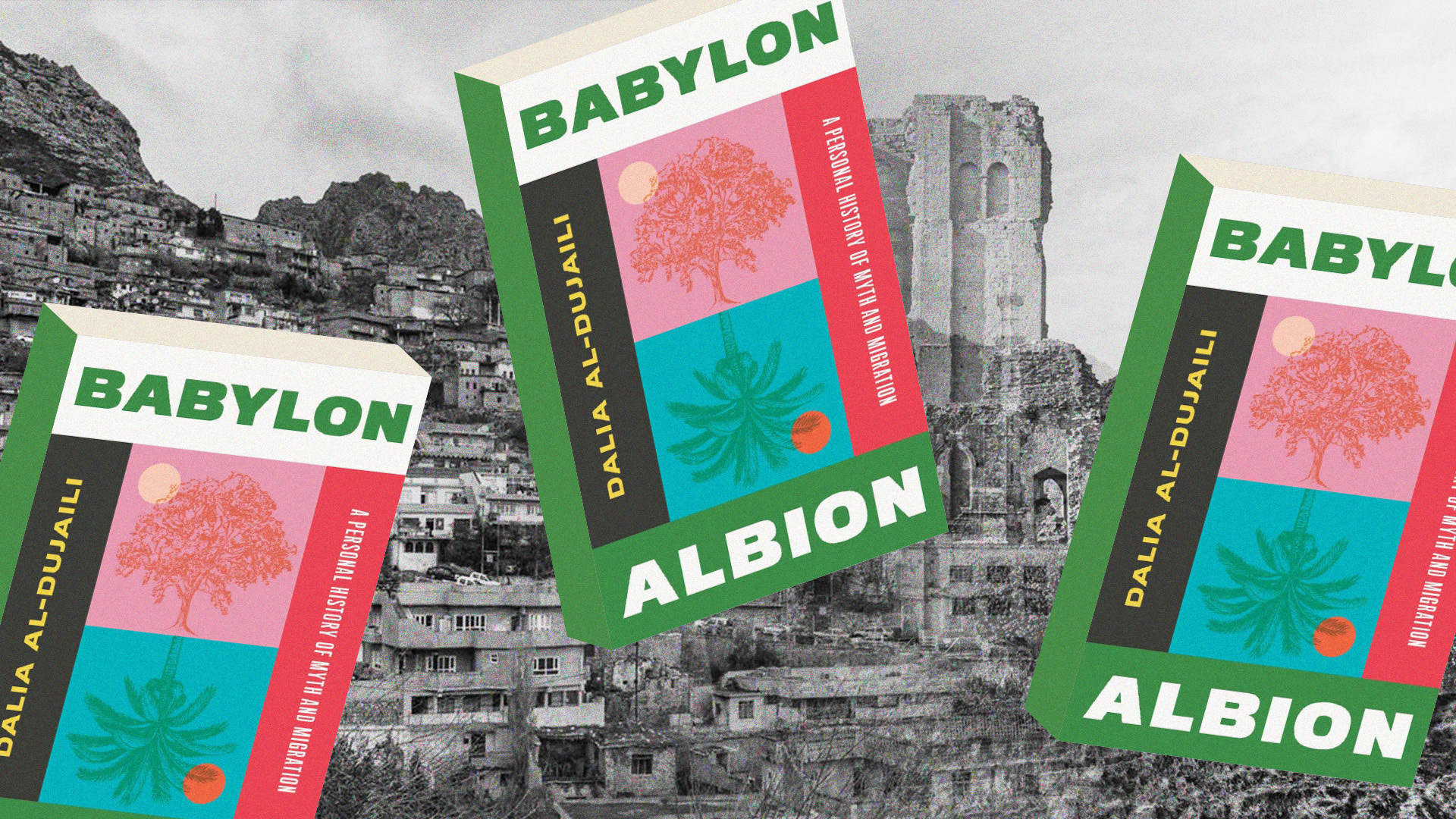
Her debut book, Babylon, Albion, is an exploration of that identity. Through a mixture of poetry, as well as deep dives into ancient mythology and religious scripture, she takes us on a journey through her life as she navigates her British upbringing and Iraqi heritage. It sets out to answer why she feels so at home in the natural world, and how nature can be a healing force in times of disparity, for all of us. We spoke to Dalia from her blooming garden in Surrey, where she sat shaded under a mature flowering tree – a fitting backdrop for our conversation.
What sparked the idea for the book?
The book was motivated by my entire experience of being who I am, growing up where I’ve grown up, and having a multiplicity of identities. I wrote it because I wanted to explore that question for myself: “What is my identity?” and why I feel such a draw to the natural world. One experience that inspired me to start writing the book was with a group called The Visionaries, which is run by a wonderful guy called Max Girardeau. He took young leaders camping in the Lake District, and it was one of the most healing and inspiring things I’ve ever done in my life. After I came back from that trip, I had a lot of thoughts, feelings and emotions, and I just felt like writing it all down. So I started writing. Babylon, Albion actually started as a photo collage. I’m a very visual person. I’m a writer at heart, but I’m also an editor of photography, visual culture and art. The cover of the book was one of the first collages that I made. It was an oak tree and a palm tree. I cut them in half and stitched them together, and then I started making all these digital collages out of images. I would look at the images and just let the words come to me. Poems I’ve read, poems that I’ve grown up with, hymns, prayers, art. It was quite a spiritual process at first.
The book draws on a lot of themes that tie nature in with your life. What does nature mean to you?
It’s my life. I think nature is God, in the sense that nature creates everything, and nature is life. In terms of nature and how it relates to my identity as a second-generation immigrant, it’s the question this book is asking, one that I don’t really have an answer to. As a second-generation immigrant, to put it plainly, I feel like the natural world is the most pure place that I can relate to because I am a placeless person. Most diaspora feel that way, in the sense that they don’t call a single place home. When you are placeless, I feel like nature can fill that void for you. And because nature and land is universal, it’s a shared home. I feel a sense of deep belonging when I’m out in nature, especially in the UK. I feel most at home when I’m walking outside, whether it be in the park, or under a tree. I’m looking at a tree right now, and I feel so much more deeply connected to this tree here in Britain than I do to any sense of the British flag or the National Anthem, or stories that we got told about colonialism. I didn’t grow up in Iraq, so I find it quite hard to relate to nationalistic ideas and symbols and narratives, but I feel super connected to sand and palm trees and the rivers and songs and myths about them. So yeah, nature is a home, I think, for all of us.
Symbols of resistance and national pride for diaspora communities are often tied up with nature. Why do you think that is?
I had a really amazing conversation with Layla Feghali, who I quote a lot throughout the book. She’s written an incredible book called The Land in our Bones, where she calls plants her ‘plant sisters’. They are our plant ancestors, and essentially, if we follow Layla’s line of thinking, plants are symbols of resistance, because plants are our ancestors and are the origin of all of our founding myths, our folklore and our history. Plants are the root – pardon the pun – of our identity. In my book, I talk about the date and the date palm a lot. This is how Arabs identify Iraqis, especially because the palm tree is so core to our identity. That’s why I wanted to open the chapter of the book with the oak and the date palm. I learned a lot from Layla and her book and her work. She does incredible work. There are so many brilliant, talented, equipped guides in this space that are more knowledgeable than me. I love Layla’s way of thinking – whether I agree with it or not, I don’t know. But I still want to include those voices.
Navigating a second-generation identity is a complicated thing, and it can be difficult to tether down this idea of belonging. What sort of lessons can we learn from the natural world when it comes to our identity?
If we look at the natural world, we find that we are trying to fight nature by trying to fit ourselves into the mould that a colonial world has created and forced on us. And identity is not that simple, and neither is nature. There’s a great quote in the introduction to the book, Living Mountain by Nan Shepherd, which describes the mountain: “Thrilled by the alterity of the Cairngorm granite, by a mountain-world which ‘does nothing, absolutely nothing, but be itself’.” There’s no point in trying to imagine a mountain wanting to identify as a hill. It’s a mountain. And there’s nothing you can do about that. You can’t shape-shift it and force it into something that it’s simply not. It’s beautiful and powerful in the way that it is. Like the mountain, my identity is beautiful and powerful just the way it is. I don’t need to go either this way or that way. I can just be who I am in my wholeness.