Map outlines state, federal statutes on the books

As employers continue to adopt artificial intelligence across recruiting, hiring, promotion, discipline, scheduling, monitoring and workforce analytics, state lawmakers are responding in very different ways.
Some states have enacted laws directly regulating employer use of AI in employment decisions, while others have focused on adjacent issues such as privacy, public-sector governance, healthcare-specific restrictions, or consumer-facing chatbot rules that do not meaningfully reach workplace tools. Still others have not enacted any AI-specific employment law, leaving employers primarily governed by existing federal anti-discrimination, labor, privacy and other generally applicable legal frameworks.
See also: AI regulation is reshaping the HR world faster than most employers realize
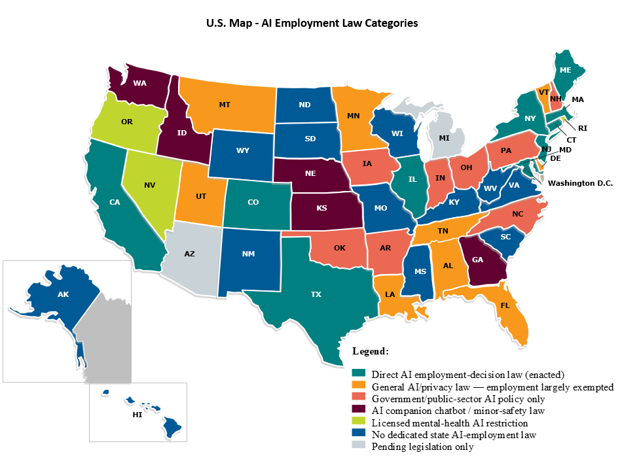
The map below organizes states into seven categories to show where direct regulation exists, where related but more limited laws have been enacted, and where legislation remains pending only.

| Category | What it means |
| Direct AI employment-decision law (enacted) | The state has enacted a law or regulation that directly governs employer use of AI, automated decision tools, or similar computational processes in employment decisions such as hiring, promotion, discipline, discharge, or other terms and conditions of employment. These are the states where AI use in HR is itself the object of regulation, rather than only indirectly affected by broader laws. |
| General AI/privacy law — employment largely exempted | The state has enacted a broader consumer privacy, automated decision-making, or AI disclosure law, but employment-related data or employer HR functions are largely carved out. These laws may be important from a broader compliance perspective, but they generally do not operate as direct workplace AI laws for most private employers. |
| Government/public-sector AI policy only | The state has enacted AI-related requirements that apply to government agencies, public bodies, or public employers, rather than to private employers generally. These laws may require policies, governance measures, or human review in the public sector, but they do not impose broad private-sector workplace AI obligations. |
| AI companion chatbot / minor-safety law | The state has enacted a consumer-facing AI chatbot or youth-safety law requiring disclosure or imposing restrictions on certain chatbot interactions, usually in contexts involving minors or public-facing consumer tools. These laws are included because they are part of the broader state AI landscape, but they expressly exclude or do not meaningfully regulate internal employer HR tools. |
| Licensed mental-health AI restriction | The state has enacted a sector-specific law limiting how AI may be used by licensed mental health professionals, healthcare providers, or similar regulated actors. These laws do not function as general employment AI statutes, but they can directly affect employers in healthcare, counseling, education, or behavioral-health settings. |
| No dedicated state AI-employment law | The state has not enacted a law specifically regulating employer use of AI in employment decisions. Employers in these states are still subject to existing federal and state legal frameworks, including anti-discrimination, disability accommodation, wage and hour, privacy, labor, biometric and unfair or deceptive practices laws, even without an AI-specific statute. |
| Pending legislation only | Bills addressing employer AI use have been introduced or are under consideration, but they have not yet been enacted. These states are important to watch because they may soon move into one of the enacted-law categories, but for now employers remain governed by existing law rather than a new AI-specific state statute. |
Enacted employment-specific AI laws
California
California has adopted one of the broadest AI-employment frameworks through regulations under the Fair Employment and Housing Act, effective Oct. 1, 2025. Those rules apply to any business with at least five employees total, so long as at least one employee is located in California, and they cover not only sophisticated AI systems but any computational process that helps decide who gets hired, promoted, disciplined, or otherwise receives an employment benefit.
The California rules reach tools even where they merely influence the ultimate decision rather than make it outright, including resume screeners, scoring tools, productivity and behavioral scoring systems, scheduling algorithms and similar technologies. They also embrace disparate-impact principles: Facially neutral automated decision systems that adversely affect applicants or employees based on a protected characteristic are impermissible unless the employer can show the practice is job-related and consistent with business necessity. Employers are also unlikely to avoid exposure simply by outsourcing to a vendor, because both the vendor and employer can be implicated if the tool is discriminatory.
California’s privacy regime also now reaches automated decision-making technology. Effective Jan. 1, 2026, the California Consumer Privacy Act requires businesses to conduct a risk assessment before using automated decision-making technology to make a significant decision concerning employees or applicants, or where the use otherwise presents a significant risk to employees, such as inferring intelligence, aptitude, performance, reliability, location, or movements based on systematic observation.
Connecticut
Connecticut’s Artificial Intelligence Responsibility and Transparency Act applies to employers doing business in Connecticut, employers with employees in Connecticut, and employers accepting job applications from Connecticut residents if they deploy automated employment-related decision technology. The law turns on function rather than labeling: If the AI tool does not “meaningfully alter” the employment-related decision, the statute’s requirements do not apply.
Beginning Oct. 1, 2026, using an automated employment-related decision process in a way that causes an adverse employment decision based on protected status violates the Connecticut Fair Employment Practices Act. The statute further provides that use of automated employment-related decision technology is not a defense to a discrimination complaint. Any employer filing WARN Act notices also must disclose to the Connecticut Department of Labor whether layoffs are related to AI or another technological change. A second phase begins Oct. 1, 2027, when employers deploying an automated employment decision tool intended to interact with applicants or employees must tell those individuals in plain language that they are interacting with the technology.
Illinois
Illinois has been an early mover in employment-specific AI regulation. Its Artificial Intelligence Video Interview Act took effect in January 2020 and applies when employers ask applicants for Illinois-based positions to record video interviews that are then analyzed by AI. The law targets asynchronous, applicant-submitted videos rather than ordinary live video interviews with a human interviewer.
Before requesting such a video interview, employers must notify the applicant that AI may be used, explain how the AI works and what general characteristics it uses to evaluate applicants, and obtain the applicant’s consent. The statute expressly provides that an employer may not use AI to evaluate applicants who have not consented.
Illinois has now moved beyond video interviewing. Effective Jan. 1, 2026, HB 3773 amends the Illinois Human Rights Act to prohibit employers from using AI that has a discriminatory effect in recruitment, hiring, promotion, renewal of employment, training, discharge, discipline, tenure and other terms and conditions of employment. The amendment expressly recognizes disparate impact, not just discriminatory intent, and also bars use of zip codes as a proxy for protected classes. It also requires employers to notify employees and applicants when using AI in covered employment contexts, including through workplace notice postings and employee handbooks.
New Jersey
New Jersey’s Division on Civil Rights has made clear through its Guidance on Algorithmic Discrimination that automated employment decision tools are subject to the same disparate-impact analysis as human decision-making under the New Jersey Law Against Discrimination. New Jersey makes clear that employers cannot outsource compliance risk to the vendor that built the tool.
New York
New York City’s Local Law 144 remains one of the most significant enacted AI hiring laws in the country, with enforcement beginning July 5, 2023. The law applies based on where the candidate or employee is located, not where the employer is headquartered, which means it can reach remote hiring even if the employer has no physical presence in New York City. Before using a covered automated employment decision tool, employers and employment agencies must conduct a bias audit within the prior year, publish a summary of the most recent audit on their website, and notify candidates that the tool will be used, how it will be used, and what data will be collected.
Texas
Texas has taken a different approach from states centered on disparate-impact enforcement. The Texas Responsible Artificial Intelligence Governance Act applies broadly to persons or entities doing business in Texas, producing products or services used by Texas residents, or developing or deploying AI systems in Texas. For employers, the law prohibits development and deployment of AI systems that intentionally discriminate against protected classes in violation of state or federal law. The statute expressly provides that disparate impact alone is insufficient to establish a violation, signaling an intent-focused approach to enforcement.
Enacted laws tangentially related to employment AI
Arkansas
Arkansas Act 159, signed Feb. 25, 2025, broadens the definitions of “likeness” and “photograph” to include AI-generated reproductions. That has practical implications for employers using AI-generated employee testimonial videos, AI-voiced advertisements, or digitally altered staff images, because it heightens the need for explicit consent from the individual whose likeness or voice is being recreated.
Arkansas also enacted Act 848, signed April 17, 2025, requiring public employers to establish formal policies governing use of AI and automated decision tools. The law requires employee training, public accessibility of those policies upon request, and human final review if AI is used to screen applicants, score performance, or assist disciplinary decisions.
Maine
Maine’s L.D. 61, enacted Jan. 11, 2026, regulates employer surveillance and applies to all Maine employers regardless of size. Although not drafted as an AI statute, the law broadly defines surveillance in a way that reaches AI-driven keystroke monitoring, productivity or activity scoring software, biometric monitoring, and similar algorithmic tracking tools. Employers using surveillance must inform job applicants during the interview process and provide annual written notice to impacted employees. The law also prohibits employers from requiring workers to install surveillance tools on personal devices without permission, and employees may decline such requests.
Maine also enacted House Bill 1397 regulating AI use in certain mental health services. The law permits AI for administrative support such as scheduling, reminders, billing and general logistics, but prohibits licensed mental health providers from using AI to deliver therapy, make independent clinical decisions, or generate unsupervised therapeutic recommendations.
Maryland
Maryland’s Facial Recognition in Employment Interviews Law restricts employers’ use of facial recognition during applicant interviews. Specifically, an employer may not use a facial recognition service to create a facial template during an applicant’s interview unless the applicant consents. Although the statute does not expressly use the term “artificial intelligence,” it was enacted in response to AI-driven hiring assessments that analyze facial movements, word choice, and vocal patterns to produce candidate scores.
Massachusetts
Massachusetts has not enacted a stand-alone AI employment statute, but Attorney General guidance applies the state’s anti-discrimination law directly to AI systems. That guidance prohibits developers, suppliers, and users of AI systems from deploying technology that discriminates on the basis of a legally protected characteristic, including algorithmic decision-making that relies on discriminatory inputs or produces discriminatory results. Applied to employment, Massachusetts employers may not use AI in hiring if it has the purpose or effect of disfavoring a person or group based on a protected characteristic.
Nevada
Nevada’s AB 406 took effect July 1, 2025, and prohibits public schools from using AI to perform the functions and duties of school counselors, school psychologists and school social workers relating to mental health. While not a general employment law, it has clear implications for employers in education and mental-health-adjacent settings that are considering AI substitution for licensed professional roles.
Tennessee
Tennessee’s ELVIS Act, enforced as of July 1, 2024, has implications for employers using AI-generated voice and likeness technology. Employers may face exposure if they use AI to generate marketing materials, training videos, IVR systems, or internal communications featuring a cloned voice or likeness of an identifiable person without authorization.
Sector-specific state laws
Several states have enacted sector-specific laws that are not general employment AI statutes but may directly affect employers in healthcare, behavioral health, or public-sector settings.
For example, Louisiana requires healthcare providers to verbally notify patients before recording visits for AI transcription, effective Aug. 1, 2026. Oregon restricts use of protected nursing titles to market or label AI products in healthcare settings. Rhode Island has enacted coordinated laws restricting AI’s role in therapeutic decision-making, requiring written-consent workflows for AI recording or transcription in therapy contexts, and imposing related documentation obligations.
Proposed and emerging legislation to watch
Colorado
Colorado’s SB 26-189 is enacted but not yet effective; it is scheduled to take effect Jan. 1, 2027, and enforcement has been stayed pending litigation and rulemaking. When effective, the law will shift Colorado toward a lighter transparency model built around pre-use notice, post-adverse-outcome disclosure, and a right to seek human review or reconsideration of adverse consequential decisions. The law also adopts a comparative-fault framework between AI developers and deployers and makes clear that contractual provisions cannot shield a developer or deployer from liability for its own discriminatory acts.
Delaware
Delaware’s HB 380 was passed on June 16, 2026. If enacted, beginning January 1, 2027, certain uses of AI tools to screen resumes, score interviews, or generate workforce analytics reports informing hiring, promotion, or discipline would fall within Delaware privacy law for that processing activity.
Massachusetts
Massachusetts’ F.A.I.R. Act remains pending in committee. As proposed, it would require annual independent third-party audits, public disclosure of those audits, strict consent and notice requirements, meaningful human oversight, and a ban on emotion and gait recognition technology.
Michigan
Michigan’s Responsible Artificial Intelligence Security for Employees Act, introduced February 24, 2026, remains pending. As drafted, it would largely prohibit employers from using automated decision tools to make employment-related decisions, subject only to limited carveouts for screening large volumes of applications or assessing job skills.
New York
New York’s S8706-B would add a new Labor Law section requiring certain covered businesses to report annually to the Department of Labor on AI’s effect on hiring and workforce changes. The report would include estimates of employees displaced, hours reduced, employees hired or hours increased due in full or in part to AI, positions left unfilled because of AI, and descriptions of AI objectives, human oversight, frequency of use, sensitive-data usage, and risk-reduction measures.
Employer takeaways
- Assume “AI in HR” is now a legal-risk category of its own. Laws are increasingly targeting tools that help make or materially influence employment decisions, including resume screeners, interview-scoring tools, productivity and behavioral scoring systems, scheduling algorithms and similar systems.
- Start with a full inventory of where AI touches the employment lifecycle. A recurring theme across states is that coverage often turns less on how a tool is labeled and more on how it is actually used and whether it meaningfully alters or materially influences an employment decision. Employers should map AI use across recruiting, hiring, interview review, performance management, productivity monitoring, scheduling, discipline, layoffs and employee communications now, before a regulator or claimant forces that exercise.
- Treat disparate-impact risk as the primary compliance issue. Employers can face exposure when AI tools produce discriminatory effects, even absent intent. In practice, that means employers should validate selection criteria, watch for proxy variables and be prepared to defend business necessity where required.
- Do not assume the vendor owns the legal risk. Multiple jurisdictions make clear that an employer generally cannot outsource compliance by pointing to a third-party vendor, even where the product is commercially marketed as compliant or bias-tested.
- Build notice and disclosure into your standard workflows. Several laws require employers to notify applicants or employees when AI is being used in recruiting, hiring, promotion, discipline, or other employment actions, and in some cases to explain how the tool works or what data it collects.
- Preserve meaningful human review, especially for adverse outcomes. States are increasingly favoring a real human backstop for consequential decisions, whether by requiring human review, allowing reconsideration requests, or signaling that fully automated employment decision-making is particularly risky. Even where a law does not flatly ban automated tools, employers are better positioned if they can show a human decision-maker reviewed the output rather than rubber-stamped it.
- Make sure your AI-driven decisions are explainable after the fact. If challenged, the employer must be able to identify the data points the software used and explain the role the tool played in the hiring or firing decision. That exact same logic is built into current bias-audit, explanation, reporting, and profiling frameworks. At the end of the day, using tools that lack transparency just creates growing practical and legal risk.
- Audit high-risk tools before deployment and re-test them periodically. Even where an assessment is not expressly required, voluntary testing and documentation may become critical evidence if a tool is later challenged.
- Use extra caution with biometrics, facial analysis and AI-scored video interviews. These tools may also trigger recordkeeping and reporting duties when employers rely solely on AI analysis to screen candidates.
- Remember that AI compliance is not just about hiring. Maine’s new surveillance law reaches broad forms of electronic employee monitoring, including AI-driven productivity or activity tracking, and Connecticut now requires WARN filers to disclose whether layoffs are related to AI or technological change. New York also is pushing toward annual reporting on AI’s impact on hiring and workforce displacement, underscoring that workforce governance issues now extend beyond recruiting into monitoring, restructuring and strategic workforce planning.
Conclusion
The state-law framework governing workplace AI is expanding quickly and unevenly, with employers facing not only AI-specific employment laws but also adjacent rules on discrimination, privacy, surveillance, biometrics and other worker-facing uses of technology.
Even where a state has not enacted a stand-alone workplace AI statute, employers still may face risk under existing federal and state frameworks, including anti-discrimination, privacy and related laws.
What employers should do now: Inventory AI tools across the employment lifecycle, review obligations state by state, pressure-test vendor arrangements, and confirm where notice, consent, human review, bias testing, or impact assessments may be needed before those tools are used in high-stakes employment decisions.