Ask ten HR managers what’s in their company’s flexible benefits plan, and you’ll get ten different answers. But almost all of them will mention books and periodicals allowance.
It’s one of those components that is in the salary structure, saves employees real tax every year, and yet gets treated like a formality most of the time.
The problem starts when an employee actually tries to claim it. The bill they submitted doesn’t have a GSTIN. Or the finance team rejects it because the receipt looks off. And all of a sudden, a tax-free allowance becomes a fully taxable one, and no one really knows why.
In this article, we cover what books and periodicals allowance actually is under Indian tax law, how much you can claim in FY 2026-27, what a valid bill looks like, and how you can report it correctly in your ITR.
What is Books and Periodicals Allowance Under Indian Income Tax Law?
Books and periodicals allowance is a salary component that lets employees claim tax-free reimbursement for money spent on books, journals, newspapers, and other professional publications.
It falls under Section 10(14) of the Income Tax Act 1961, which allows exemption on allowances given to meet expenses incurred in the performance of official duties.
Legal Definition Under Income Tax Act 1961
Section 10(14)(i) of the Income Tax Act 1961 allows exemption on special allowances tied to official duties. The expense must be spent entirely for the job, not for personal use.
Rule 2BB of the Income Tax Rules lists which allowances qualify, including academic and research allowances, uniform allowances, and conveyance allowances.
Books and periodicals allowance is administered under the broader Section 10(14)(i) framework and is treated by most employers under the general “expenses in performance of duties” category.
Purpose and Role in Employee Compensation
Companies include this allowance for two reasons:
- Encourages continuous learning whether that’s a new technical manual, a trade journal, or a daily newspaper subscription
- Keeps the reimbursement tax-free for the employee as long as bills are submitted
An employee’s CTC includes books and periodicals allowance, the total salary package that includes basic pay, allowances, provident fund contributions, and other benefits.
Allowances like this one are paid in addition to basic salary, and every rupee spent on qualifying books or subscriptions comes back tax-free when the bills are in order.
Knowing what this allowance is only matters once you know how the exemption actually works.
Recommended reading: Understanding CTC vs Take-Home Salary
Books and Periodicals Allowance Exemption Section and Tax Treatment
Getting the tax treatment right depends on knowing exactly which section applies and what conditions trigger the exemption. Here’s what the law actually says:
Section 10(14)(i) of Income Tax Act 1961
Section 10(14)(i) is the provision covering special allowances granted to salaried individuals to meet expenses incurred in the course of their duties.
Books and periodicals allowance is administered under this provision. The exemption is directly proportional to the amount you actually spend on qualifying purchases.
Rule 2BB of Income Tax Rules
Rule 2BB spells out which allowances qualify under Section 10(14)(i). The named categories include conveyance allowance, helper allowance, and academic and research allowance.
Books and periodicals aren’t literally named in the six sub-clauses of Rule 2BB(1), which is worth flagging. In practice, employers administer it under the general Section 10(14)(i) wording.
The Income Tax Department’s own Allowances allowable to tax payer reference for AY 2026-27 lists helper allowance and research allowance as exempt “to the extent of expenditure incurred for official purposes.” Books and periodicals are treated on the same principle.
Rule 2BB spells out which allowances qualify under Section 10(14)(i). The named categories include travel allowance, daily allowance, conveyance allowance, helper allowance, academic and research allowance, and uniform allowance.
Is Books and Periodicals Allowance Taxable?
The tax treatment depends entirely on how it’s paid out.
If your employer reimburses you based on bills submitted, the amount is fully exempt with proper documentation. If your employer pays it as a fixed monthly amount without asking for bills, the entire amount becomes taxable as salary income.
Getting money in your bank account labeled “books allowance” doesn’t automatically make it tax-free. What makes it tax-free is proving you actually spent it.
Once you know the section that applies, the next question is how much of it you can actually claim.
Books and Periodicals Allowance Exemption Limit for FY 2026-27
Knowing the allowance is exempt is one thing. Knowing how much of it you can actually claim is another.
There’s no statutory cap on this exemption. What determines the exempt amount comes down to two numbers: the allowance built into your CTC, and what you actually spend on qualifying purchases.
Maximum Exemption Limit Calculation
The maximum exempt amount equals the lower of the actual bill value or the CTC allowance amount.
When it comes to calculating the exempt amount, you measure the actual bill value against the CTC allowance amount, and whichever is lower becomes your exempt figure.
Here’s a rough example of how it looks in practice:
| Allowance in CTC | Actual bills submitted | Exempt amount | Taxable amount |
|---|---|---|---|
| ₹12,000/year | ₹12,000 or more | ₹12,000 (full allowance) | ₹0 |
| ₹12,000/year | ₹8,000 | ₹8,000 (actual spend) | ₹4,000 added to salary |
| ₹12,000/year | ₹0 (no bills) | ₹0 | ₹12,000 fully taxable |
If you’re consistently spending less than your CTC allocation, talk to your HR about reducing it. An unused taxable component just adds to your tax liability without any real benefit.
Tax Treatment When Allowance Exceeds Actual Expenditure
Purchases should relate directly to your profession or job role. General or personal reading material may not qualify, even if you submit a valid bill for it.
To claim the exemption, keep proof for every purchase. Receipts, invoices, or any other valid document showing what you bought and how much you paid will support your claim.
Once you know your limit, the next step is figuring out what actually counts as a valid expense.
Expenses Covered Under Books and Periodicals Allowance
The scope is broader than most employees realise. It’s not just physical books. Here are some of the expenses covered:
1. Eligible Print Publications
- Purchase of books, including technical manuals, textbooks, and reference books
- Subscription fees for journals, magazines, and newspapers
- Membership fees for relevant publications
2. Digital Books and E-Periodicals Eligibility
Online e-book subscriptions are also eligible under this allowance. There’s no official list naming approved digital platforms.
Employees should treat digital subscriptions and e-books as eligible when backed by a valid digital invoice, rather than assuming every platform automatically qualifies.
3. Professional Journals and Trade Publications
Technical manuals, trade journals, and industry publications tied to your job role qualify. This includes newspaper subscriptions and journal memberships relevant to your field.
4. Ineligible Expenses Under This Allowance
Books need to connect directly to your profession or job role. Purchases meant for resale don’t qualify, and general or personal reading material with no professional relevance typically won’t hold up as a valid claim.
Books and Periodicals Allowance Eligibility Criteria
Eligibility depends on more than just having the allowance in your CTC. It also comes down to who you are, where you work, and what you’re buying.
Private Sector Employee Eligibility
For private sector employees, the standard requirements are:
- You must be a full-time permanent employee
- You must complete a minimum of one year of employment with the company
- You submit original bills and purchase receipts
- Purchases should be traceable through bank or credit card statements
Government Employee Provisions
Government employees follow a different mechanism entirely. The Department of Expenditure’s2018 Office Memorandum replaced the older monthly bill-based system for newspaper reimbursement with a certification-based structure.
Under the current rates:
- Secretary or equivalent: as per actuals
- Additional Secretary or equivalent: ₹1,100
- Joint Secretary or equivalent: ₹850
- Director / Deputy Secretary / Under Secretary / Section Officer or equivalent: ₹500
Officers submit a half-yearly certificate confirming the expenditure was incurred, and the amount is reimbursed without requiring individual bills.
Job Role and Professional Relevance Requirements
The purchase needs a direct link to your profession or job role. This is the one condition that applies regardless of whether you’re in the private sector or government service, and it’s the detail most claims get rejected over.
Now that you know what qualifies, the real question is whether you’re eligible to claim it.
How to Claim Books and Periodicals Allowance: Step-by-Step Process
Claiming this allowance comes down to three things: keeping the right paperwork, submitting on time, and understanding how approval works.
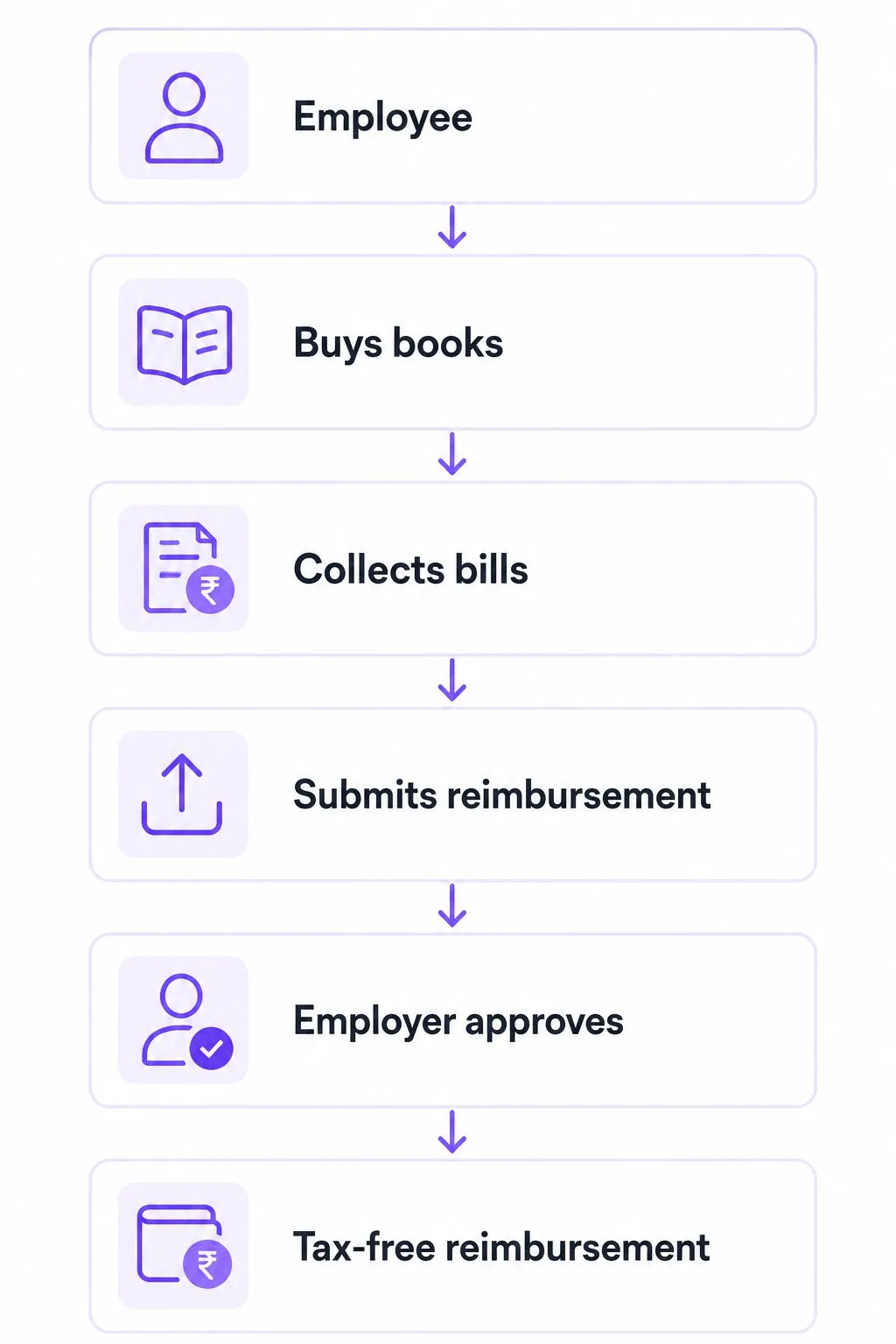
Alt text: Employee reimbursement process for books and periodicals allowance from purchase to tax-free reimbursement.
Image caption: Books and periodicals allowance reimbursement process.
Step 1: Documentation Requirements for Claims
Keep proper paperwork on file to ensure your reimbursement stays non-taxable under an accountable plan. When you follow this process, you won’t pay extra tax on the amount, as long as you submit all required documents and follow the policy correctly.
Collect receipts, note the business purpose, and submit on time. These three habits keep your reimbursement exempt.
Step 2: Claim Submission Timeline and Frequency
Claim your books and periodicals allowance through reimbursement, and submit within one year of the purchase date. Attach your bills and transaction records with the claim. Miss the one-year window, and you lose the ability to claim the disbursement.
Step 3: Approval Process and Authority Hierarchy
Submit your claim through your company’s reimbursement or approvals module. The reviewer opens your claim and checks the details you’ve submitted, including your bills and the amount requested.
Once your bills are verified, the reviewer approves the claim and enters the approved amount. You’ll receive this amount in your next month’s pay run.
If a claim doesn’t hold up, the reviewer rejects it, or rejects specific line items by setting the approved amount for those items to zero.
Get the paperwork and timing right, but that alone won’t get your claim through. Your bill still has to hold up.
Books and Periodicals Allowance Bill Format and Receipt Requirements
Here’s what a valid bill needs to include, and how to keep your records audit-ready.
Essential Elements of a Valid Bill
A bill that will hold up to scrutiny needs to include, at minimum:
- Name, address, and GSTIN of the seller
- Date of issue
- Description of the item purchased
- Total value of the supply
- Signature or digital signature of the supplier
These align with the 16 mandatory fields listed under CGST Rule 46 for a valid GST invoice.
Sample Bill Format Template
A basic bill structure for claiming this allowance looks like this:
| Sl. no. | Bill/cash memo no. & date | Book/periodical name | Purchased from | Amount (Rs./paise) |
|---|---|---|---|---|
| 1 | ||||
| 2 | ||||
| 3 | ||||
| Total |
Signature of the employee: __________________ Date: __________________
For HR records and action: Reimbursement amount passed for: Rs. __________________ Signature: __________________ Date: __________________
Digital Receipt and Invoice Acceptability
Payroll platforms increasingly link with apps like Gmail, Slack, and Teams to make receipt submission easier. They also provide downloadable reimbursement expense data, which supports audits and tracking.
Audit Trail and Record Keeping Requirements
Accurate accounting and timely filing matter, along with reconciling your GSTR-2B, to avoid the risk of credit reversals, penalties, or audit issues.
Missing records, an incomplete invoice, or a missing GST detail can create problems when claiming input tax credits and staying compliant during assessments.
Even a perfect bill won’t help if you’re claiming it under the wrong tax regime. Let’s have a look at the different regime.
Books and Periodicals Allowance in New Tax Regime vs Old Tax Regime
Many employees never check whether their tax regime still allows this exemption. Books and periodicals allowance is fully exempt under the old regime. Under the new regime (Section 115BAC), it isn’t available at all.
Here’s how the two regimes compare on this and related allowances:
| Exemption / Allowance | Governing Section | Old Tax Regime | New Tax Regime (Sec 115BAC) |
|---|---|---|---|
| Books and Periodicals Allowance | 10(14)(i) | Exempt on actuals | Not available |
| House Rent Allowance (HRA) | 10(13A) | Exempt (least of 3 formulas) | Not available |
| Leave Travel Allowance (LTA) | 10(5) | Exempt on actual travel fare | Not available |
| Standard Deduction | — | ₹50,000 | ₹75,000 |
| Helper/Assistant Allowance | Rule 2BB(1)(d) | Exempt to extent of expenditure | Not available |
| Research Allowance | Rule 2BB(1)(e) | Exempt to extent of expenditure | Not available |
| Conveyance Allowance (specially-abled) | Rule 2BB(1)(c) | Available | Available |
Once you’ve claimed and confirmed your regime, the final step is making sure it shows up correctly on your return.
Reporting Books and Periodicals Allowance in ITR Filing
Claiming the exemption is only half the job. It also needs to show up correctly when you file your return.
How Books Allowance Appears in Form 16
Your Form 16 Part B shows two key figures before any exemptions are applied:
- Your salary for the year
- The value of any perks or benefits you received alongside your pay
Everything else, including your books and periodicals exemption, gets calculated from these starting numbers.
Your employer prepares Form 16 after factoring in the bills and claims you submitted through the year.
If your books and periodicals allowance was approved and reimbursed correctly, it should already reflect in the exempt portion of your salary breakup.
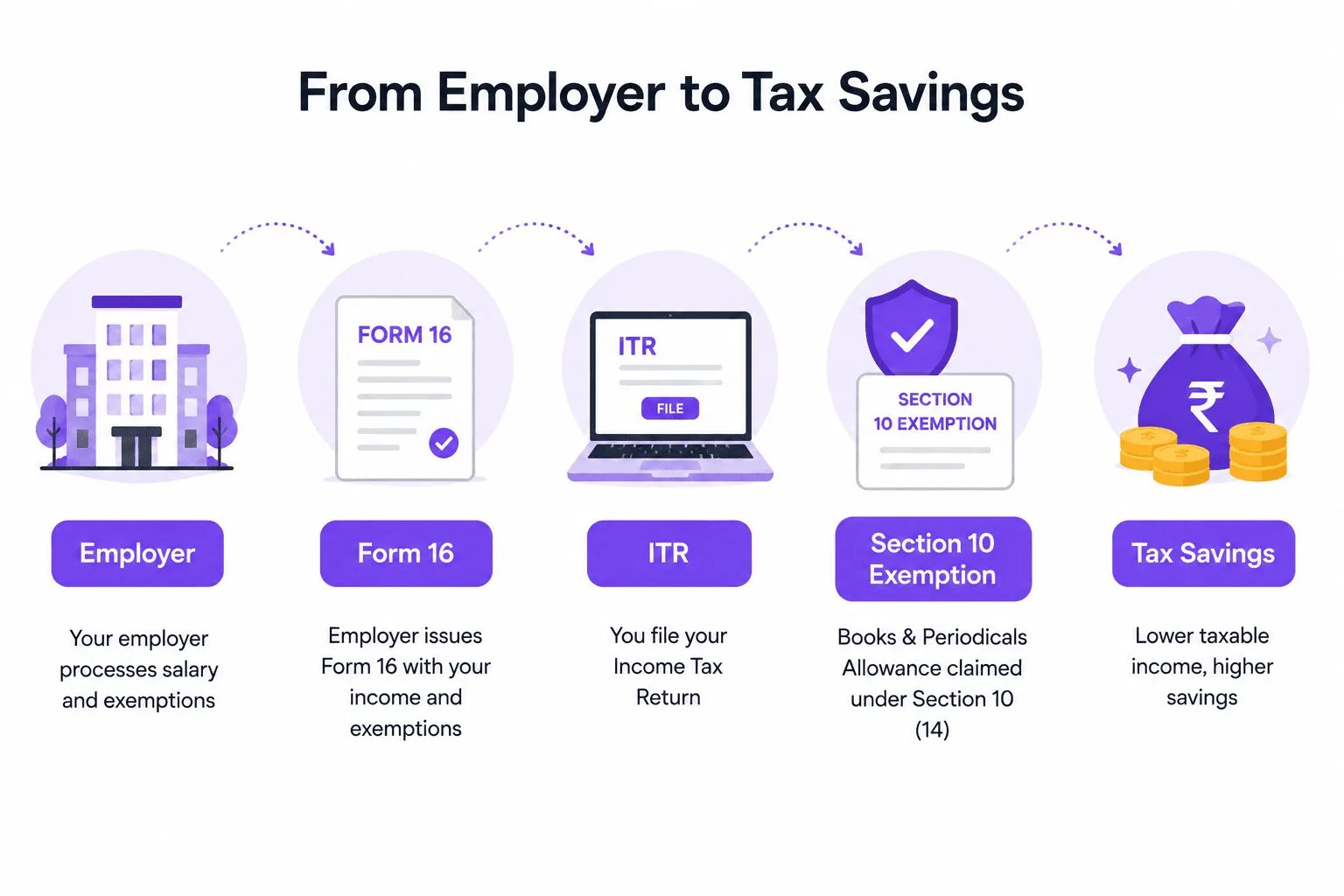
Alt text: Flow showing how books and periodicals allowance is reported from Form 16 to ITR for tax savings.
Image caption: How books and periodicals allowance is reported in your ITR.
ITR Schedule Salary Reporting
When filing your return, the exempt portion is reported at field B1(ii), “Less allowances to the extent exempt u/s 10.”
Select the appropriate allowance category from the dropdown and enter the exempt amount. The net salary at B1(iii) is auto-calculated, deducting the exempt allowances from your gross salary.
You can claim Section 10 exemptions by reporting eligible exempt income in the correct fields. Keep your Form 16, salary slips, and other supporting proof on hand to back your claim.
Common Filing Mistakes to Avoid
Most mistakes happen when employees forget to claim the exemption, or claim it the wrong way. Here’s what to watch for:
- Forgetting to claim the exemption at all, and letting the entire disbursed amount stay taxable.
- Reporting the full CTC allowance as exempt, when only actual expenditure or the CTC amount, whichever is lower, qualifies
- Claiming this exemption after opting into the new tax regime, where it isn’t available
- Not cross-checking the exempt amount in Form 16 against what was actually reimbursed during the year
Employees handle their part by claiming and filing correctly. HR and finance still need to manage this allowance on their end.
Payroll Processing and Accounts Treatment for Book Allowance
HR and finance teams manage this allowance from the other side of the process, handling configuration, accounting, and compliance once an employee’s claim comes in. Here’s what that looks like in practice.
Payroll System Configuration for Book Allowance
How this allowance gets configured depends on your payroll operating model:
- In-house model: Payroll processing and compliance accountability stay entirely within your organisation’s payroll team
- Hybrid model: Compensation approvals and master data management stay in-house, while a specialist provider handles compliance and statutory filings
This allowance is within the broader CTC breakup, which shows employees exactly what they’re entitled to and how much lands as in-hand salary.
Recommended reading: Payroll Audits: What Employers Should Do Before, During, and After
Accounting Entries for Reimbursement Claims
Reimbursement isn’t the same as a refund. A refund returns money because something was returned or overpaid. Reimbursement, on the other hand, happens after an employee incurs a work-related cost.
This distinction also affects how it’s treated on payroll. Reimbursement of expenses is different from salary, since it only covers costs the employee already paid for business reasons. It isn’t counted as part of monthly pay.
GST Input Tax Credit Considerations
For employers, there’s a small but useful ITC angle. Under Section 17(5) of the CGST Act, certain expenses like food, club memberships, and specific travel benefits are blocked from input tax credit. Books and periodicals purchases aren’t on that blocked list.
If the invoice is issued in the employer’s name with a valid GSTIN, and the purchase is for business use, the employer can potentially claim ITC on the GST paid. Given the nuance here, this is worth confirming with a tax advisor before assuming ITC eligibility.
Books and Periodicals Allowance vs Other Tax-Exempt Allowances
Books and periodicals allowance isn’t the only exemption available. Employees can combine it with several other exemptions to reduce their taxable salary, and it helps to see where each one stands.
Comparison with Related Allowances
| Allowance | Governing Section | Exemption Basis | New Regime? |
|---|---|---|---|
| Books and Periodicals | 10(14)(i) | Actual expenditure or CTC amount, whichever is lower | Not available |
| Conveyance Allowance | 10(14)(i) + Rule 2BB(1)(c) | Actual expenditure for official purposes | Not available |
| HRA | 10(13A) | Least of 3 statutory formulas | Not available |
| LTA | 10(5) | Actual domestic travel fare | Not available |
How It Fits Within Flexible Benefits Plan
A Flexible Benefits Plan (FBP) is a plan included in an employee’s salary, made up of components like:
- Food coupons
- Books and periodicals allowance
- Conveyance allowance
Several FBP allowances aren’t tax-free under the new regime, so your tax regime choice should factor into which components you pick.
Stacking Multiple Exemptions for Maximum Tax Savings
Employees can save up to ₹60,000 in taxes through a well-structured flexible benefits plan:
- HRA: up to ₹3,00,000 annually (₹25,000 monthly), partially tax-exempt
- LTA: up to ₹1,50,000 annually, tax-exempt to the extent bills are submitted
- Books and periodicals: a smaller amount, but still part of the stack
Combined with conveyance, the cumulative exemption meaningfully reduces taxable salary, provided you’re on the old tax regime.
Managing Books and Periodicals Allowance on Keka
A growing team brings a lot of moving parts to this allowance. Employees submit bills at different times, managers approve in batches, finance validates each claim, and payroll processes them without breaking Form 16 accuracy at year-end.
Keka handles this end-to-end within its payroll and FBP modules:
- Employees declare their allocation at the start of the year through the FBP portal.
- Bills upload directly from the self-service dashboard, with digital receipts and mobile photos supported.
- Managers and finance review, approve, or reject claims through defined workflows.
- Approved amounts flow automatically into payroll as tax-free reimbursements.
- Form 16 reflects the correct exempt amount at year-end, without manual reconciliation.
If your team is still processing FBP claims over email and spreadsheets,book a free demo to see how much time you’ll save.
Frequently Asked Questions
1. What is a book and periodical allowance?
It’s an employee benefit exempt under Section 10(14) of the Income Tax Act 1961, covering expenses on books, newspapers, journals, and periodicals required for professional duties, subject to actual-expenditure proof.
2. Is books and periodicals allowance taxable?
It’s tax-exempt to the extent of actual expenditure incurred and documented. Any amount received beyond the submitted bills becomes taxable as salary income.
3. What is included in the books and periodicals allowance?
Qualifying expenses include professional books, newspapers, magazines, trade journals, academic publications, and digital subscriptions tied to job responsibilities. Entertainment or general-interest publications don’t qualify.
4. What is the maximum exemption limit for books and periodicals allowance?
There’s no fixed statutory upper limit. The exemption equals actual expenditure or the allowance amount in CTC, whichever is lower, subject to employer policy.
5. Which allowances are exempt under Section 10(14)?
Rule 2BB(1) names travel, daily allowance, conveyance, helper, academic/research, and uniform allowances explicitly. Books and periodicals allowance is typically administered under the general Section 10(14)(i) wording instead.
6. What bill format is required for books and periodicals reimbursement?
Valid bills should show vendor name, GSTIN where applicable, purchase date, itemized description, and amount paid, aligned with the mandatory GST invoice fields under CGST Rule 46.
7. Can digital subscriptions and e-books be claimed under this allowance?
Yes, online e-book subscriptions are a qualifying expense, as long as they’re professionally relevant and backed by a valid digital receipt or invoice.
8. Are books and periodicals allowance available in the new tax regime?
No. Section 10(14) special allowances are excluded under Section 115BAC, and Rule 2BB(3) limits the new-regime carve-out to a specific named list that doesn’t include this allowance.