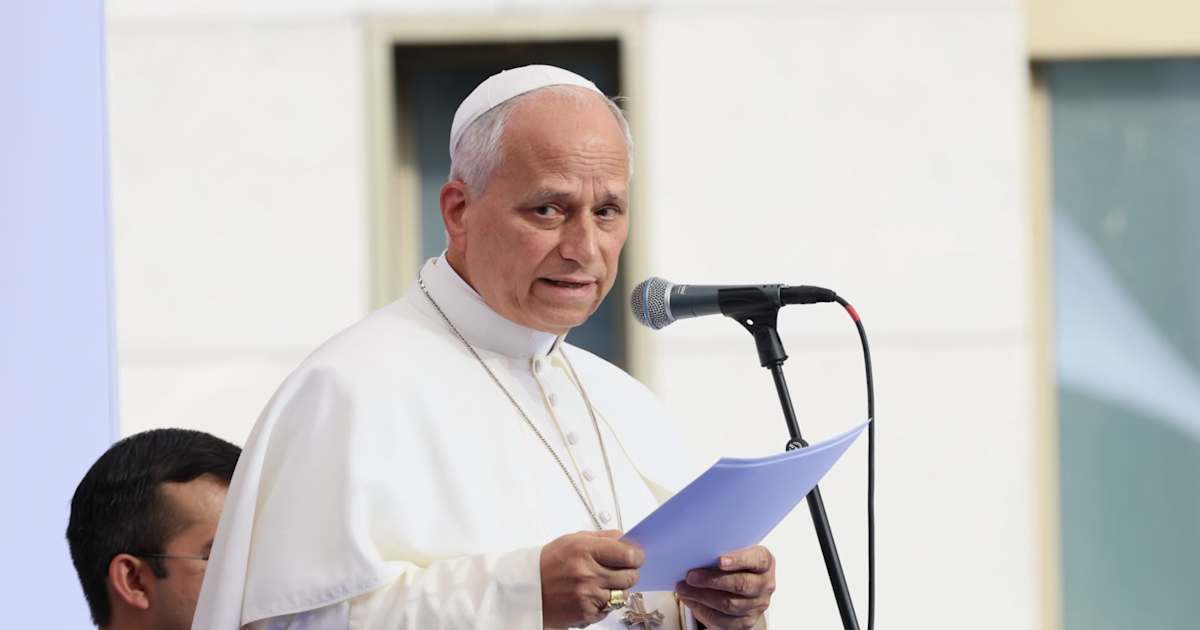
LOURDES, France — Killing the sick is neither compassionate nor normal, and being legal does not make it moral, Pope Leo XIV said Sunday, in a clear reference to France’s recent legalization of euthanasia and assisted suicide.
“I know that for some of you, because of particular illnesses and, at times, terrible pain, your horizon may appear dark, uncertain and without hope. But no human law should ever make you lose the certainty of your dignity,” the pope said during a meeting with about 5,000 sick people and caregivers at the Sanctuary of Our Lady of Lourdes on Sept. 27.
“It is precisely in the name of this inalienable dignity of the human person that we must reject the temptation to cause death under the guise of false compassion,” the pontiff added to loud applause. “It is impossible to regard causing death as something normal. What is legal is not necessarily moral.”
The popeʼs remarks on end-of-life concerns were met with applause and shouts of “Bravo.”
France legalized assisted suicide and euthanasia this summer, becoming the fifth European country to do so after Belgium, the Netherlands, Luxembourg, and Spain. In addition, Switzerland and Austria permit assisted suicide.
Euthanasia is the intentional ending of a person’s life to relieve suffering. It differs from assisted dying, in which the patient takes life-ending drugs himself, under a physician’s guidance. Both practices are prohibited by Catholic teaching.
Leo met Sept. 27 with staff and sick guests of the Accueil Notre-Dame (Notre Dame Home), a residential accommodation classified as a healthcare facility, which hosts sick, disabled, and frail pilgrims to Lourdes.
The Catholic shrine is one of the most visited in the world, drawing more than 3 million people every year, many in search of miraculous physical healing.
The 136-acre property includes the Grotto of Massabielle, where a young St. Bernadette Soubirous saw 18 apparitions of the Virgin Mary starting on Feb. 11, 1858. Today, pilgrims to the sanctuary bathe themselves in the freshwater spring Mary revealed to Bernadette.
Visitors have reported 7,000 healings since the apparitions; after lengthy investigations, the Church has declared that 72 of the recoveries were miraculous, meaning unexplainable by science.
“Here in Lourdes, the city of the sick and of hope, I appeal to the entire healthcare community to remember the profound meaning of your vocation, which is to care for a suffering person, not to eliminate that person,” Pope Leo said.
He encouraged healthcare workers to be “passionate servants of life” and cited his speech to the Jérôme Lejeune Foundation in June, in which he said, “no one ever has the right, “on the basis of laboratory algorithms, to decide the life of a given embryo or elderly person! Medicine must never become the servant of programmed death!”
Earlier in the morning, the pope addressed the French bishops’ conference, praising the bishops’ courage in opposing the legalization of euthanasia and assisted suicide.
“I encourage you to persevere, together with all people of good will who uphold the same values,” he told the bishops.
In his remarks to the sick and caregivers, Leo called for structures for palliative care and urged the healthcare field to accompany the sick with the same tenderness they receive in Lourdes.
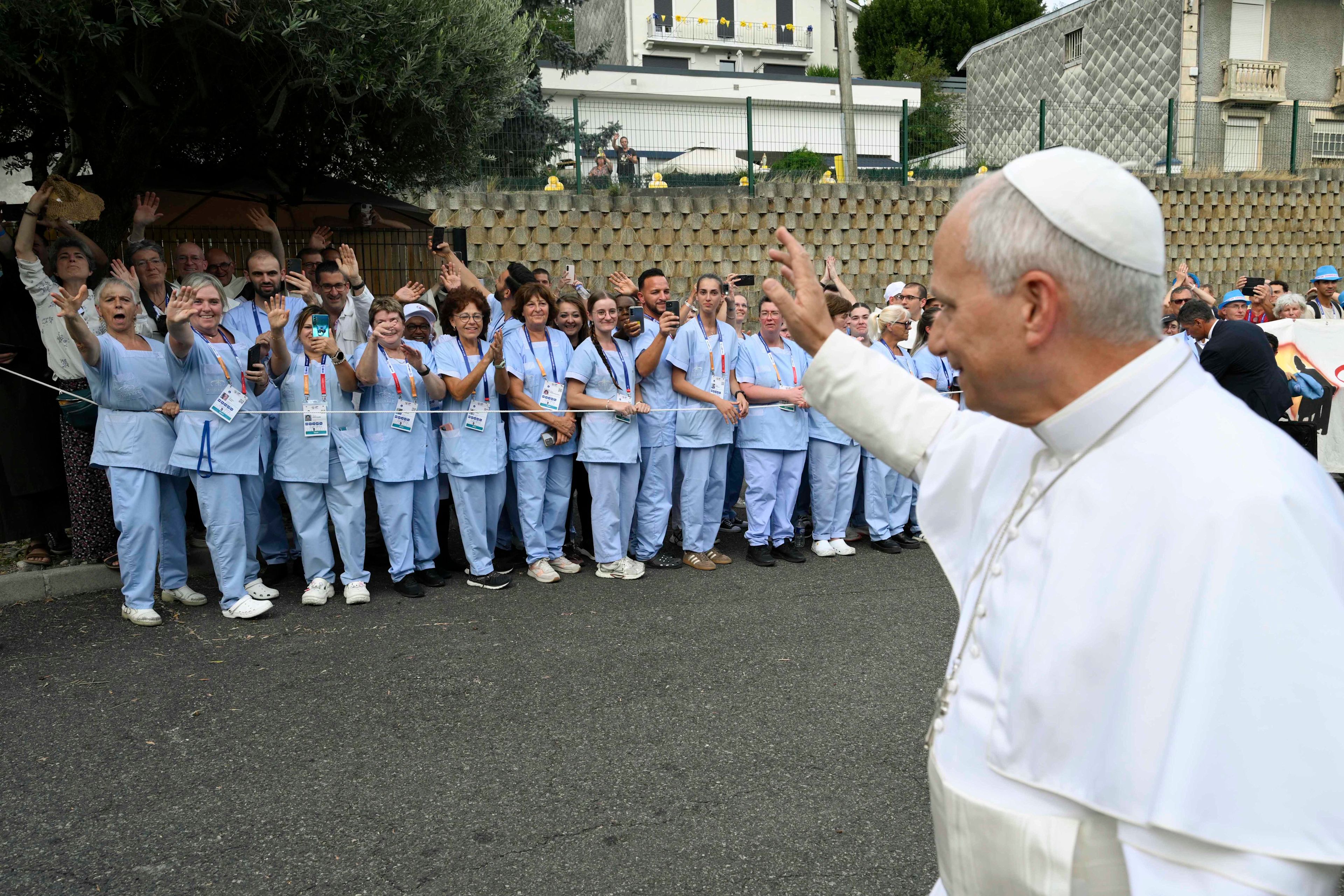
Pope Leo XIV greets medical staff and those assisted by the Accueil Notre-Dame on Sept. 26, 2027 in Lourdes, France. | Credit: Vatican Media
“Doctors, nurses, stretcher-bearers, chaplains, pastoral teams serving the sick, and so many others live out their vocation in the service of the dignity of the human person, so that the world may have life,” he said.
“Dear brothers and sisters who are sick,” he concluded, “I want to tell you that you are not a burden. You are the beating heart of our humanity and a precious treasure for the Church. I carry in my prayers the trials you are going through.”
Immediately after the meeting, the pope walked next door to greet the Discalced Carmelite nuns whose monastery faces the grotto of the apparitions from across the river Gave de Pau. The contemplative monastery was founded in 1876, just 18 years after Mary appeared to St. Bernadette.
Rosary procession
The pope’s final event in Lourdes was a candlelit rosary procession on the shrine’s esplanade.
“We are gathered this evening to respond to the request that Our Lady addressed to the priests through St. Bernadette: ‘People should come here in procession,’” Leo said in his remarks after the rosary.
“How moving it is to see the faithful from one generation to the next respond with love and trust to the tender invitation of the Virgin Mary. … I give thanks to the Lord that I, too, may respond this evening to the call of our Mother, becoming a pilgrim among pilgrims.”
Pope Leo said, “Those who are sick are privileged witnesses to this transfiguration of our lives through faith and love of God and neighbor.”
“It is indeed necessary to come here and take part in this procession with you, dear brothers and sisters who are ill, in order to experience this full reality,” he added. “As Pope Pius XII wrote: ‘No one has ever seen such a procession of suffering in one spot on earth, never such radiance of peace, serenity, and joy.’”
The pontiff called it a miracle to find “serenity and joy amidst suffering.”
“God grants us the grace to perceive the life-giving presence of the risen Christ among us. He enables us to look beyond our earthly horizon towards a more distant future, a future of immeasurable happiness in God,” he said.
Federica Postiglione has been a volunteer for 30 years with Unitalsi, an Italian organization that brings sick people to Lourdes on pilgrimage. Leo’s visit to the Catholic shrine happened to coincide with the group’s national pilgrimage, which this year brought more than 4,000 pilgrims, including some children receiving cancer treatment in Naples, Italy.
“The pilgrimage in itself is already truly a gift and a grace,” Postiglione, who is from Naples, told EWTN News. “Coming to Lourdes … with the pope, was very, very beautiful.”
She said it was wonderful to experience the anticipation that the pilgrims in their group felt as they waited to see Pope Leo in his encounter with the sick and their caregivers.
Her favorite moment was seeing how, “despite the fences, he wanted to meet and greet some of the sick people.”
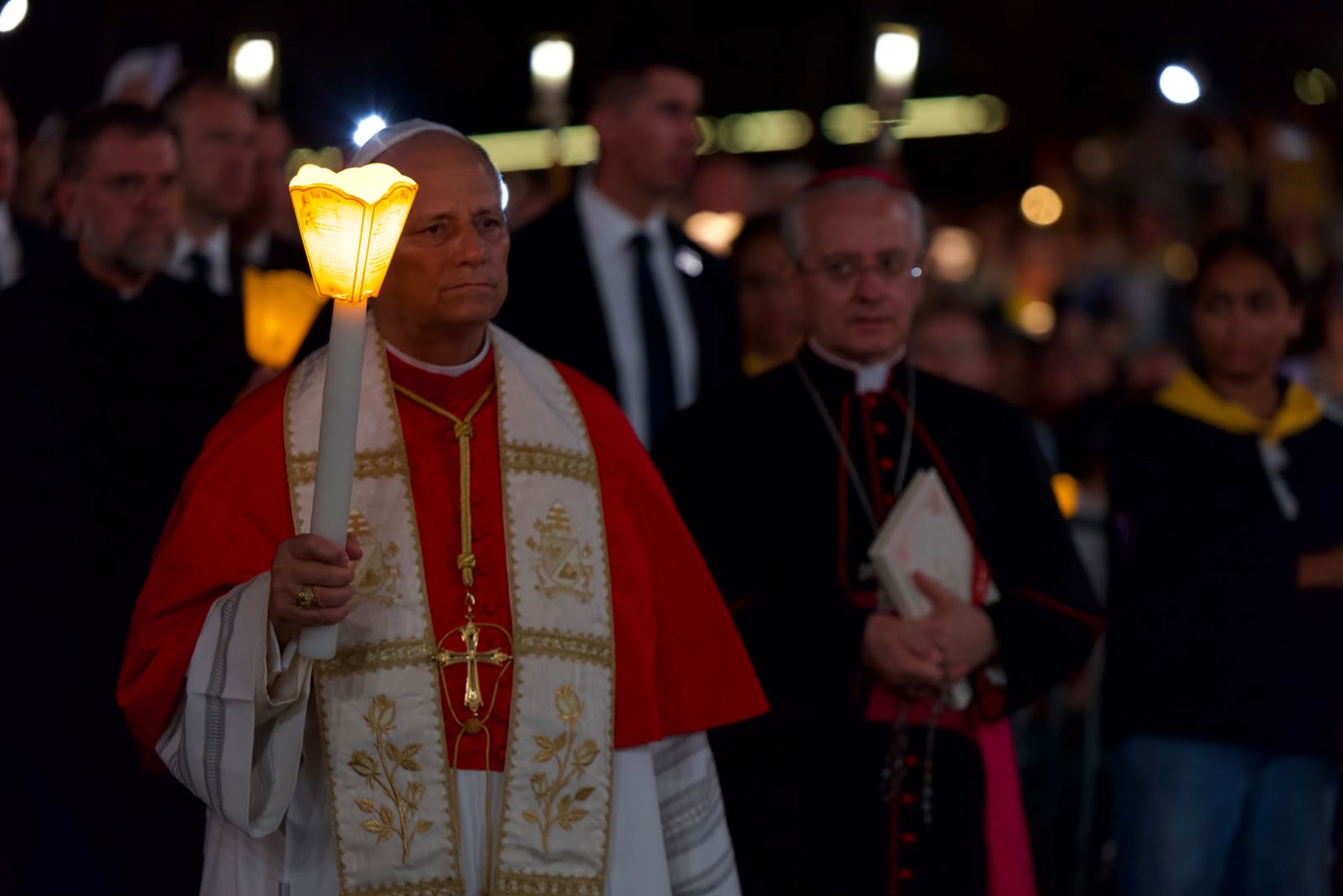
Pope Leo XIV leads an evening rosary and candlelit procession Sept. 27, 2026 at the Lourdes grotto, a Marian pilgrimage site in France dedicated to Our Lady of Lourdes. | Credit: Daniel Ibáñez/EWTN News
Virginia Wildemann, a pilgrim from Long Island, N.Y. participating in the rosary procession, said she had experienced illness and “wanted to come here and I wanted to bathe myself in the holy water, and it’s a shame because we can’t do that because the pope is here, and being that he’s here, everything is closed — the grotto, the baths — but I was able to get some holy water, which is fantastic.”
Wildemann said she absorbed the pope’s message that “we have to stay together, pray together, love one another, be kind to one another, and that’s what Jesus wants of us — to love your neighbors as you love yourself.”
Ron Denissen, a pilgrim from Delaware, said when his parish group booked the trip to Lourdes, he didn’t know the pope would be visiting the Marian pilgrimage site at the same time. Denissen said he stood along the road near his hotel as the pope passed in a motorcade.
“And as he was coming by, I yelled, ‘Go Bears!’ because he’s a Chicago fan,” referring to the Chicago Bears football team, Denissen said. “And he was looking away, but then he looked over at me and waved, and I got a picture of him up close, personal, looking at me and waving. So that was pretty special.”
This story was updated at 5:45 p.m. ET on Sept. 26, 2027 to include a report about the candlelit rosary procession.