Tolkien receives England’s supreme literary accolade

In the south transept of Westminster Abbey, touched by the jeweled light of a rose window, is Poets’ Corner. Geoffrey Chaucer was buried here in 1400 — not because he wrote The Canterbury Tales, but because he was a royal official. Two centuries later, the great Elizabethan poet Edmund Spenser asked to be interred next to the father of English literature, and so began the tradition.
Forty famous writers lie beneath the worn flagstones, and another 70 are commemorated in marble, bronze, and slate. Here is Shakespeare — or at least the face we think of as Shakespeare’s. Nearby is Ben Johnson, lost in thought. Jane Austen characteristically contents herself with a modest little tablet. Charles Dickens and Rudyard Kipling, C.S. Lewis and P.G. Wodehouse are all raised, carved, or etched in this sacred space. I work nearby and, when the tourist season is over, I often linger in that soft light. Here, of all places, you feel the force of the words that adorn T.S. Eliot’s memorial: “The communication of the dead is tongued with fire beyond the language of the living.”
Now, at last, J.R.R. Tolkien is to have the supreme accolade bestowed on him. “Tongued with fire” — how often that phrase creeps into my mind when I read The Lord of the Rings to my 10-year-old.
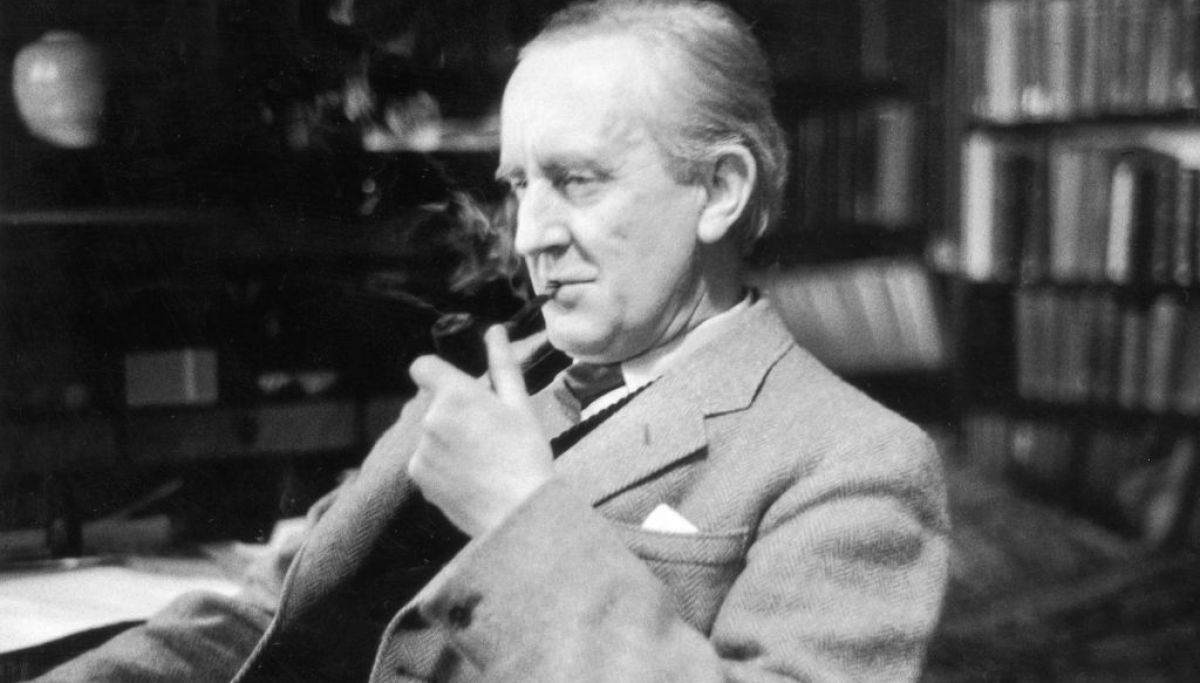
British writer J.R.R. Tolkien enjoying a pipe in his study at Merton College, Oxford. (Haywood Magee/Picture Post/Hulton Archive/Getty Images)
” data-large-file=”https://www.washingtonexaminer.com/wp-content/uploads/2026/09/GettyImages-3247205.jpg?w=696″ src=”https://www.washingtonexaminer.com/wp-content/uploads/2026/09/GettyImages-3247205.jpg?w=696″ alt=”British writer J.R.R. Tolkien enjoying a pipe in his study at Merton College, Oxford. (Haywood Magee/Picture Post/Hulton Archive/Getty Images)” class=”wp-image-4742144″ style=”width:864px;height:auto” >
If ever a novel was written to be read aloud, this is it. Tolkien freights his words with something more than their meaning, so that the act of speaking the syllables seems to fill your mouth with magic. He understood, in short, the power of incantation — as, perhaps, did most Catholics of his generation.
In his own lifetime, Tolkien was dismissed as a children’s writer with a twee line in faux-archaic language. “Not many adults will read through [The Lord of the Rings] more than once,” opined the Times Literary Supplement in 1954 in the first review. Edmund Wilson, writing in the Nation in 1956, called it “juvenile trash.” In 1961, Philip Toynbee hilariously declared: “These books have passed into a merciful oblivion.”
Even in the 1980s, it was slightly embarrassing to be seen reading Tolkien after the age of 14. Then people began to notice what had gripped Tolkien’s imagination: the power of myth, the nature of language, the longing for identity. They noticed, too, that the shape of the words almost perfectly matched the themes they described.
The Lord of the Rings begins in the style of a children’s story and then swerves into the grander, older prose style that we call Tolkienian. The swerve happens as the characters leave their familiar country and come to understand their insignificance in vast new landscapes. There is a similar swerve, oddly enough, in The Hobbit. The dwarves emerge bedraggled from their barrels, still recognizably children’s characters. When a Lakeman asks who they are, their leader replies: “I am Thorin son of Thrain son of Thror, King Under the Mountain!” From then on, the story becomes grimmer, and the language darkens commensurately.
Tolkien was a deep-dyed conservative, traditionalist and patriotic. Naturally, he saw through Adolf Hitler early on. When his publisher sold the German-language rights to The Hobbit in 1937, the Nazis asked if he was of Aryan blood. Tolkien’s reply was both magisterial and prophetic.
“If I am to understand that you are enquiring whether I am of Jewish origin, I can only reply that I regret that I appear to have no ancestors of that gifted people. My great-great-grandfather came to England in the eighteenth century from Germany. I have been accustomed to regard my German name with pride, and continued to do so throughout the period of the late regrettable war, in which I served in the English army. I cannot, however, forbear to comment that if impertinent and irrelevant inquiries of this sort are to become the rule in matters of literature, then the time is not far distant when a German name will no longer be a source of pride.”
DAN HANNAN: WHY ISRAEL IS LOSING ITS FRIENDS
Tolkien’s oeuvre is the ultimate fictional distillation of what the conservative philosopher Roger Scruton called oikophilia: longing for a lost home. They pulse with the wistfulness that every Christian sometimes feels. Indeed, with the possible exception of Giuseppe Tomasi di Lampedusa’s The Leopard, they are the greatest conservative works of fiction ever composed. “Together through the ages of the world we have fought the long defeat,” says Galadriel — one of the most religious lines ever written, and in a book which, on the surface, makes no space for God.
Tolkien set out to give England the national epic it lacked. As is their way, it took his countrymen far too long to see what was under their noses. Still, they got there in the end.