2026 Chess Olympiad Round 7: Uzbekistan Leads With 7/7 Match Wins; No Team Perfect In Women’s

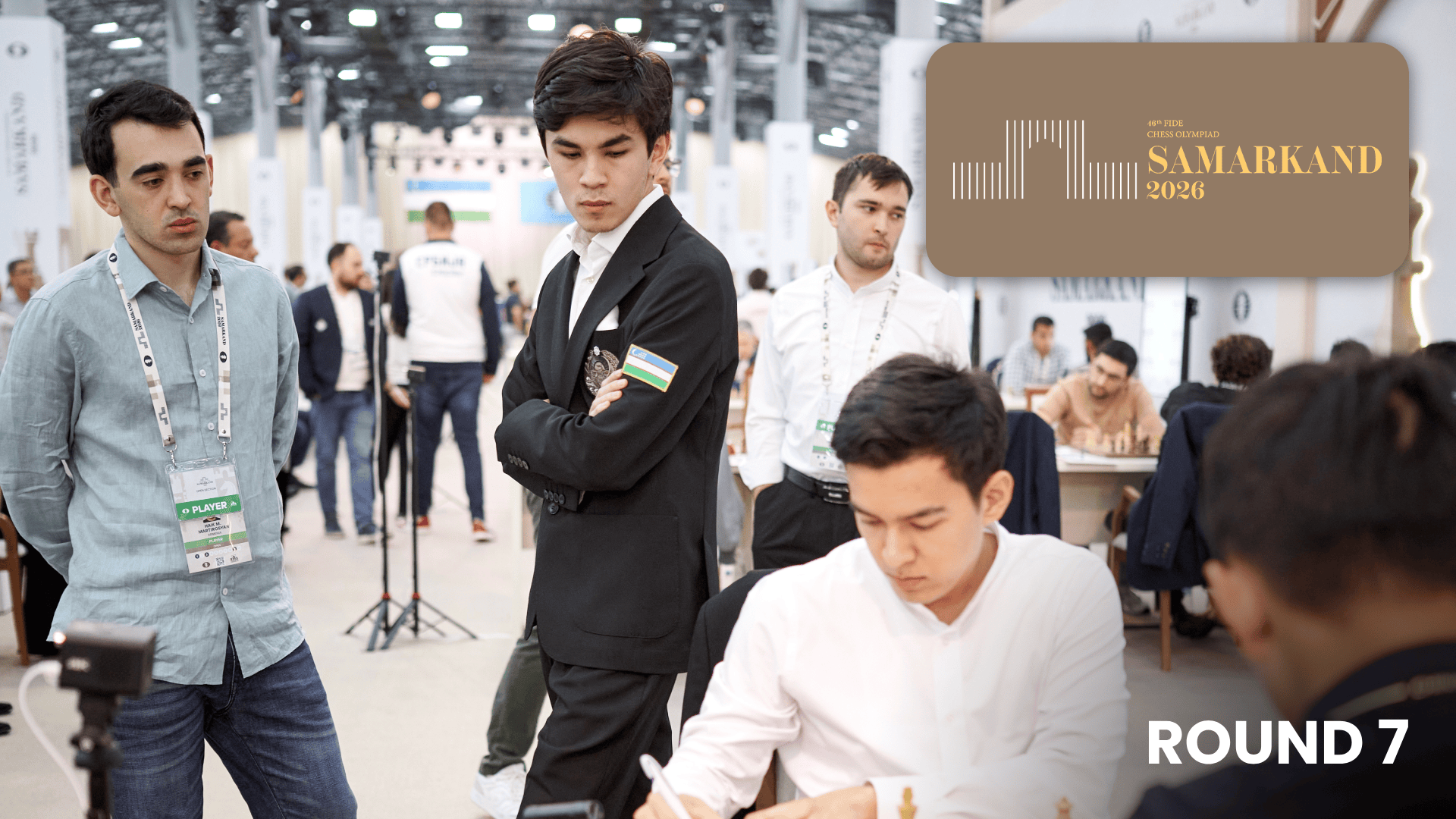
With seven out of seven match wins, Uzbekistan continues to dominate the 46th Chess Olympiad 2026, with their latest victory against China 3-1 after wins by the Nodirbeks; GM Nodirbek Abdusattorov defeated GM Ding Liren and GM Nodirbek Yakubboev beat GM Yu Yangyi. There are five chasing teams on 12/14: the Netherlands, India, Germany, Azerbaijan, and Armenia.
China and Kazakhstan scored a win apiece in a 2-2 tie that saw the last two perfect records go in the 2026 FIDE Women’s Chess Olympiad. That allowed five teams to move within a single point: top seed India, who beat Germany 3.5-0.5, second seed Georgia, who beat Poland 2.5-1.5, and three teams that pulled off upsets. Bulgaria, Armenia, and Mongolia overcame Ukraine, Azerbaijan, and France respectively. The U.S. finds itself just two points off the lead after a 3-1 win over Switzerland, with IM Carissa Yip beating GM Alexandra Kosteniuk on top board.
Round eight is on Thursday, September 24, starting at 6:15 a.m. ET / 12:15 CEST / 3:45 p.m. IST.
Open: Nodirbeks Score For Uzbekistan
Uzbekistan continues its perfect streak after defeating its closest rival, China, in round seven.
Round 7 Results | Open Top 10
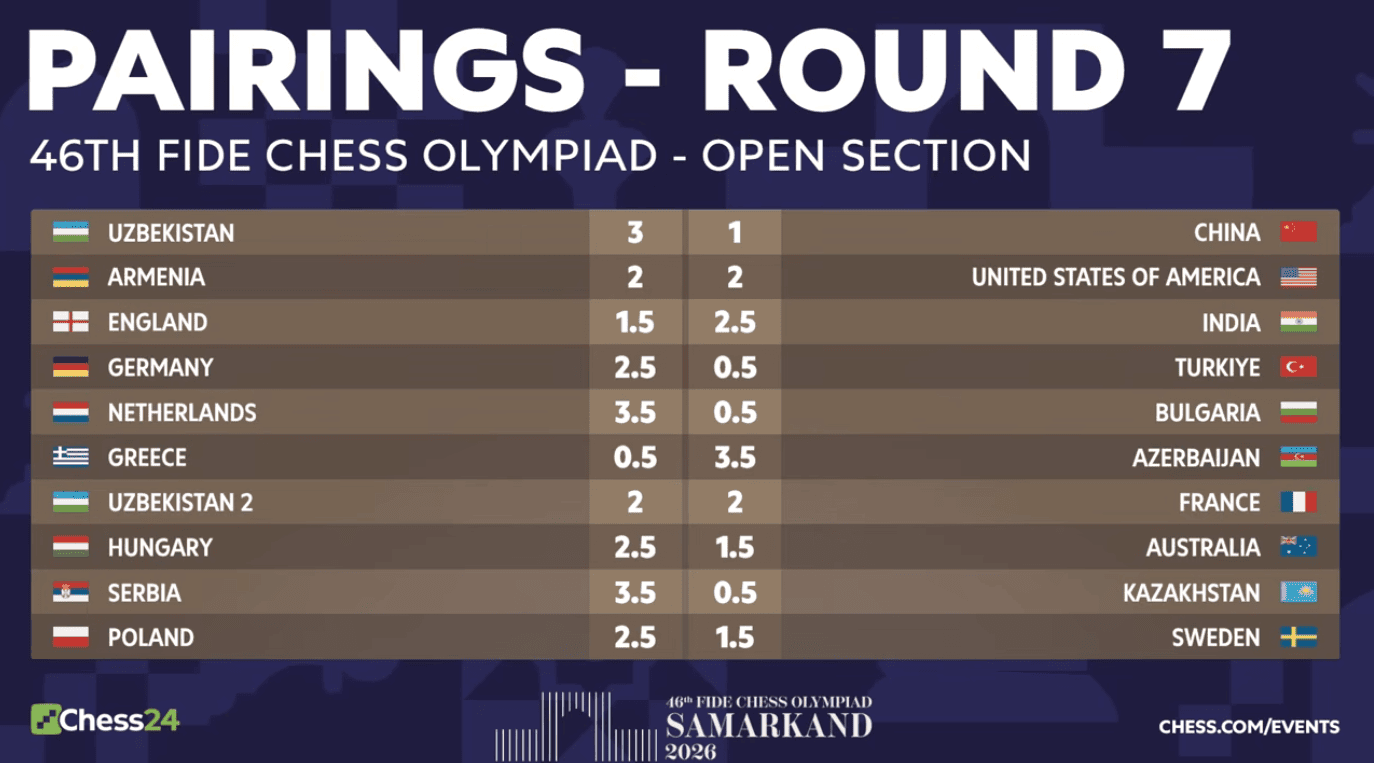
The home team leads by a full two match points, so even if they lose one match, they will still share the lead.
Open Standings After Round 7: Top 20
| # | Seed | Fed | Team | Matches | + | = | – | Points | TB1 | TB2 |
| 1 | 3 | Uzbekistan | 7 | 7 | 0 | 0 | 14 | 190 | 22.5 | |
| 2 | 6 | Netherlands | 7 | 6 | 0 | 1 | 12 | 163.5 | 19.5 | |
| 3 | 2 | India | 7 | 6 | 0 | 1 | 12 | 159 | 18.5 | |
| 4 | 5 | Germany | 7 | 6 | 0 | 1 | 12 | 155 | 19 | |
| 5 | 7 | Azerbaijan | 7 | 5 | 2 | 0 | 12 | 153 | 20 | |
| 6 | 10 | Armenia | 7 | 5 | 2 | 0 | 12 | 147 | 19 | |
| 7 | 4 | China | 7 | 5 | 1 | 1 | 11 | 172 | 19.5 | |
| 8 | 9 | France | 7 | 4 | 3 | 0 | 11 | 152.5 | 19.5 | |
| 9 | 18 | Iran | 7 | 5 | 1 | 1 | 11 | 148 | 20.5 | |
| 10 | 15 | Serbia | 7 | 5 | 1 | 1 | 11 | 140 | 18.5 | |
| 11 | 16 | Poland | 7 | 5 | 1 | 1 | 11 | 137.5 | 19.5 | |
| 12 | 20 | Czech Republic | 7 | 5 | 1 | 1 | 11 | 137.5 | 19 | |
| 13 | 1 | United States of America | 7 | 5 | 1 | 1 | 11 | 137 | 18 | |
| 14 | 30 | Uzbekistan 2 | 7 | 5 | 1 | 1 | 11 | 137 | 18 | |
| 15 | 8 | Hungary | 7 | 5 | 1 | 1 | 11 | 110 | 14.5 | |
| 16 | 23 | Romania | 7 | 3 | 4 | 0 | 10 | 160 | 19.5 | |
| 17 | 13 | Spain | 7 | 5 | 0 | 2 | 10 | 145.5 | 19 | |
| 18 | 19 | Greece | 7 | 5 | 0 | 2 | 10 | 139 | 18.5 | |
| 19 | 14 | Turkiye | 7 | 5 | 0 | 2 | 10 | 138 | 18.5 | |
| 20 | 11 | England | 7 | 4 | 2 | 1 | 10 | 137 | 18 |
Following a rest day, the teams fought with renewed energy and brought us many exciting games—especially rook endgames—in round seven.
Free day in Samarkand🇺🇿: Exploring the heart of the Silk Road
🤩 Nearly 300 players, captains and accompanying persons joined the Samarkand Cultural Program Tour on the free day of the Chess Olympiad. Eight full buses departed from the Expo around 2 p.m., heading first to the… pic.twitter.com/4rcbLMinPy
— International Chess Federation (@FIDE_chess) September 23, 2026
After the first week of play, the question ahead of the last four rounds is clear: can anyone stop Uzbekistan, or at least slow them down? Having gone through second seed India and fourth seed China, there is still potentially the top seed United States for them to get through in later rounds. But the U.S. is three match points behind.
In 2024, India was the first team to reach a perfect 14/14 score in 18 years, and two years later Uzbekistan has matched that record. Looking back to 2008, when this scoring system began, we can see how other teams have done by round seven.
Winning Team Scores By Round 7
| Country | Year | Score | Position After Round 7 |
| India | 2024 | 14/14 | 1st |
| Uzbekistan | 2022 | 12/14 | 2nd |
| China | 2018 | 11/14 | 9th |
| U.S. | 2016 | 13/14 | 1st |
| China | 2014 | 12/14 | 2nd |
| Armenia | 2012 | 11/14 | 4th |
| Ukraine | 2010 | 13/14 | 1st |
| Armenia | 2008 | 13/14 | 1st |
Board one Abdusattorov commented on the one-sided nature of the match against China, “We didn’t have any problem on a single board today,” and things went smoothly, he said.
We didn’t have any problem on a single board today.
—Nodirbek Abdusattorov
Things went well for us fairly quickly. I mean, I got a very pleasant position out of the opening, and I saw that the rest of the boards were having very comfortable positions from the opening, so I was very happy and very convinced that we will have good chances in this match.
Against 17th World Champion Ding, Abdusattorov played a controlled middlegame and eventually isolated Black’s d-pawn. Ding sacrificed it for activity, but the Uzbek number-one saw through the counterplay. GM Rafael Leitao analyzes the Game of the Day below.

GM Peter Svidler also made an approximately nine-minute video recap, which you can see embedded below.
GM Javokhir Sindarov vs. GM Wei Yi was a wildly complicated game that ended with a rook drawing against two bishops, with a pair of pawns for each side. GM Mukhiddin Madaminov, on board four, made a draw with GM Xu Xiangyu in the sharp Kmoch Variation of the Nimzo-Indian (4.f3), but on board three Yakubboev won his fifth game in six rounds for a 2993 performance so far.
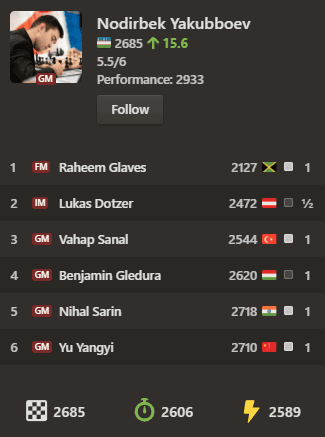
By live rating, Yakubboev is at his peak of 2713 and world number-25. With the white pieces, he managed to break down Yu’s Petroff Defense deep in an endgame that was passive but holdable. Lashing out with the active-looking 27…g5??, Yu was in big trouble when Yakubboev found 28.b4!, ignoring Black’s play and creating a bigger threat of his own.
In the FIDE interview, Abdusattorov also shared a behind-the-scenes moment for team Uzbekistan as they watched Yakubboev win the critical game against GM Nihal Sarin in round six. “After Nihal blundered with Nf5, there was a huge scream in the chat, you know, we were typing, we were texting, we were screaming, you know, it was incredible.” With India and China behind them, he said they made a “big step” toward winning gold.
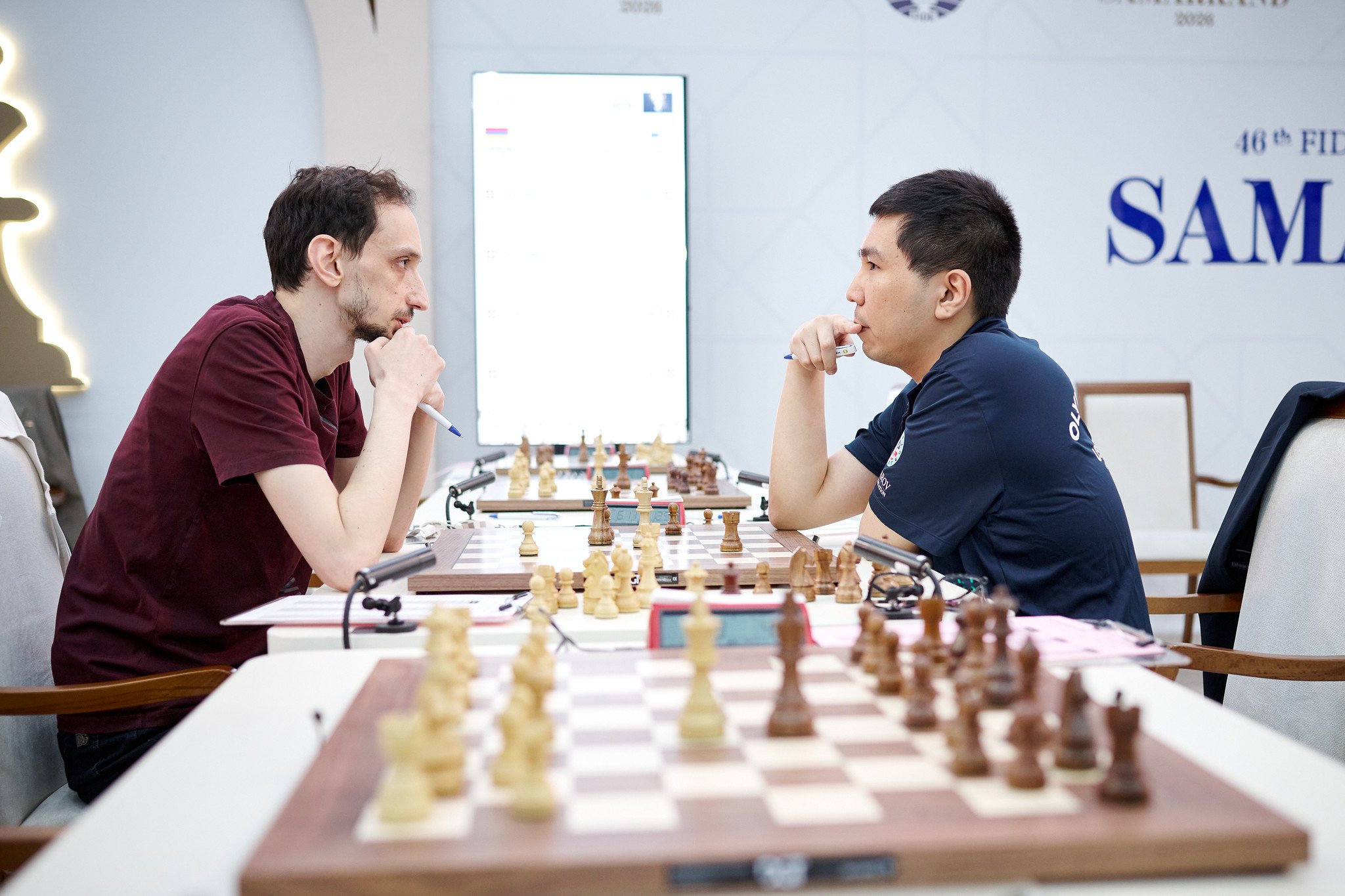
Armenia, the only other team that started the day a point behind Uzbekistan, made a draw with the United States after the two sides traded one win and one draw each. GM Awonder Liang, who had a difficult start in the tournament, won his first game back from the bench against GM Gabriel Sargissian on board four. 21.Bf6! was an unusual and awesome tactic to win a pawn, which he converted after a few more adventures along the way.

After draws on boards one and three, GM Robert Hovhannisyan was in a must-win game with the black pieces against GM Wesley So to rescue Armenia, and he delivered. The American defended a pawn-down rook endgame tenaciously, but at some point he had to find the only move 54.Kc7!! to survive. The last time So lost a game with the white pieces in an Olympiad was in Batumi 2018.
Thus the match was drawn 2-2, with Armenia still well in the running for medals.
India bounced back from the loss in round six against Uzbekistan with a convincing victory over England—a matchup that produced a friendly rivalry on our broadcast between English GM David Howell and Indian IM and eight-time Olympiad participant Tania Sachdev.
Tania Sachdev asks David Howell if India has an easier pairing today… vs. England! https://t.co/s2v88aukl7#ChessOlympiad pic.twitter.com/MqPYMMSO8D
— chess24 (@chess24com) September 23, 2026
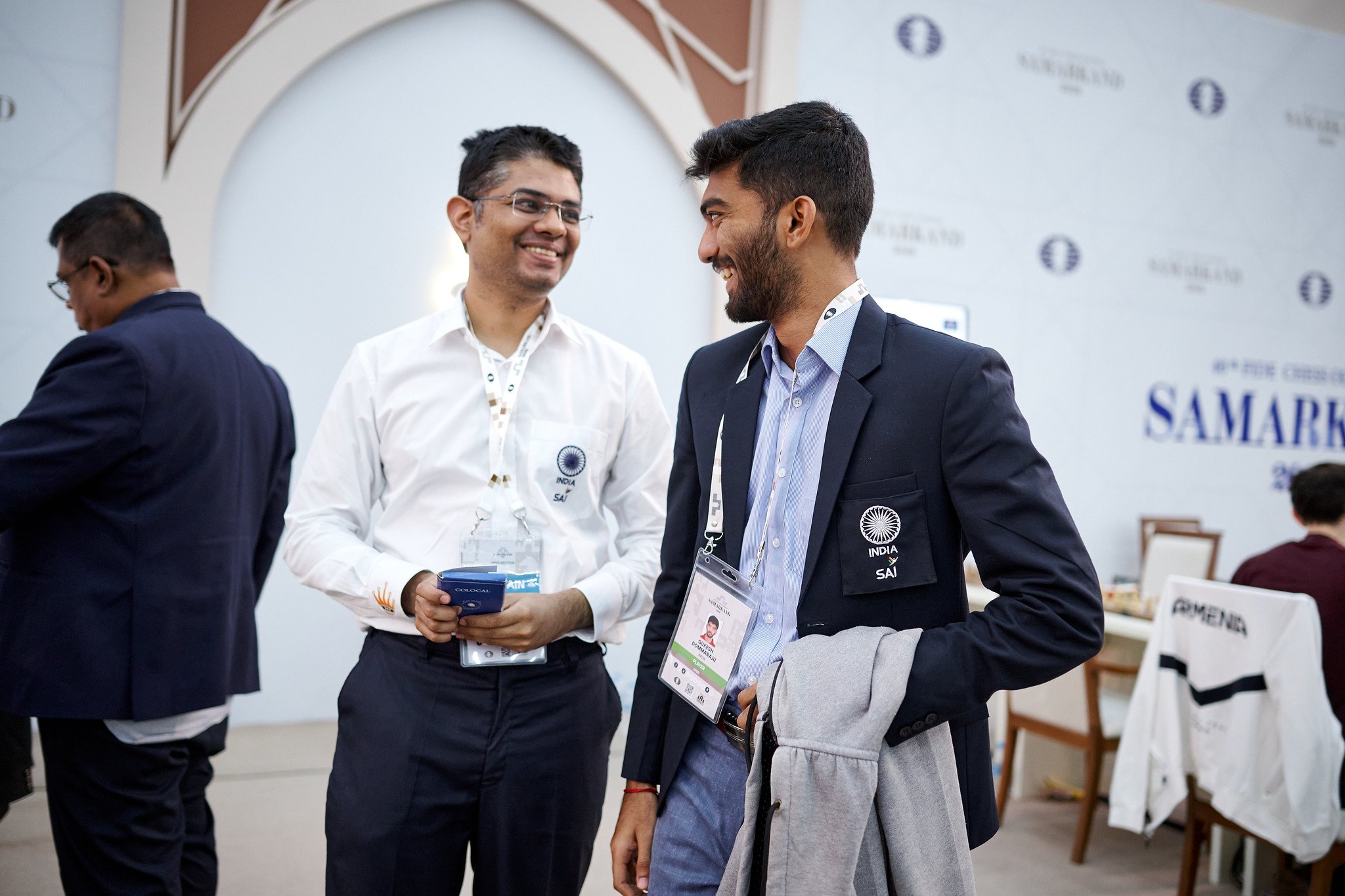
GM Praggnanandhaa Rameshbabu won against GM Nikita Vitiugov on board one, as did World Champion Gukesh Dommaraju against GM Daniel Fernandez on board four. Since his draw in round two against an IM, Gukesh has put up a nearly 2800-level performance with four wins out of five against grandmasters.
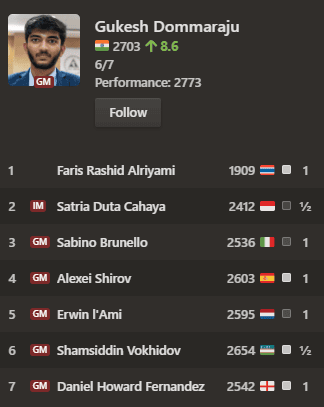
GM Arturs Neiksans connected this performance to the upcoming world championship in November: “If Gukesh plays the way he is playing so far and he, for example, gets a gold medal on board four… we might have to re-evaluate what to expect from the world championship match.”
Board one saw an opposite-sides castling slugfest, and Praggnanandhaa’s attack was just faster. 21…Na3!?+ was an excellent piece sacrifice to rip open the b-file.
Just after Praggnanandhaa’s win, GM Arjun Erigaisi offered GM Michael Adams a draw and, surprisingly, Adams accepted! This meant that even GM Luke McShane‘s win against GM Nihal Sarin on board three wasn’t enough to even the score. It’s a second loss in a row for Nihal—although India won the match 2.5-1.5—and the team will have to evaluate whether to sub in GM Vidit Gujrathi.
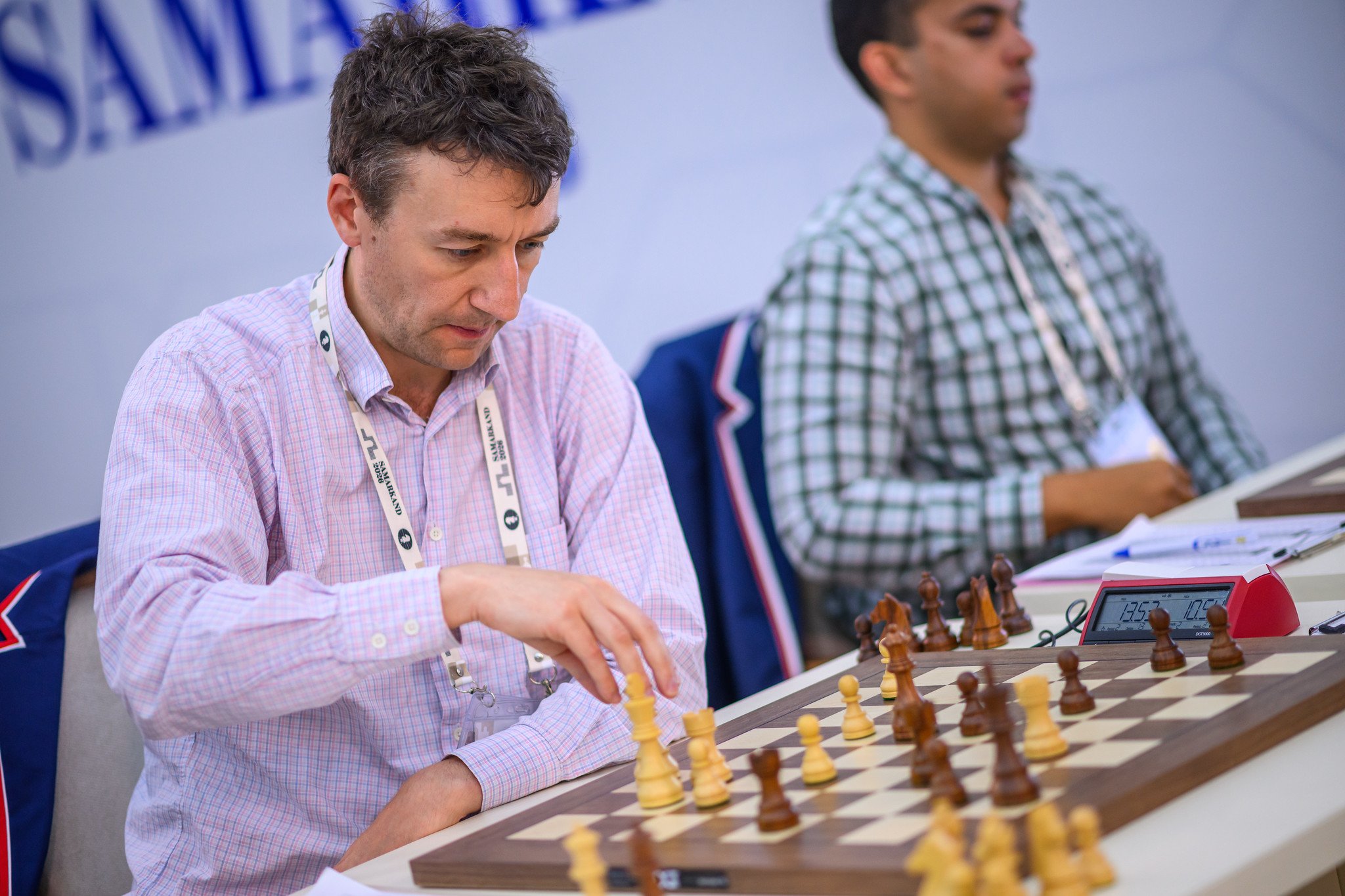
Germany won a surprisingly one-sided match against Turkiye 3-1, with the brothers GMs Frederik Svane and Rasmus Svane (on boards three and four) scoring the two wins.
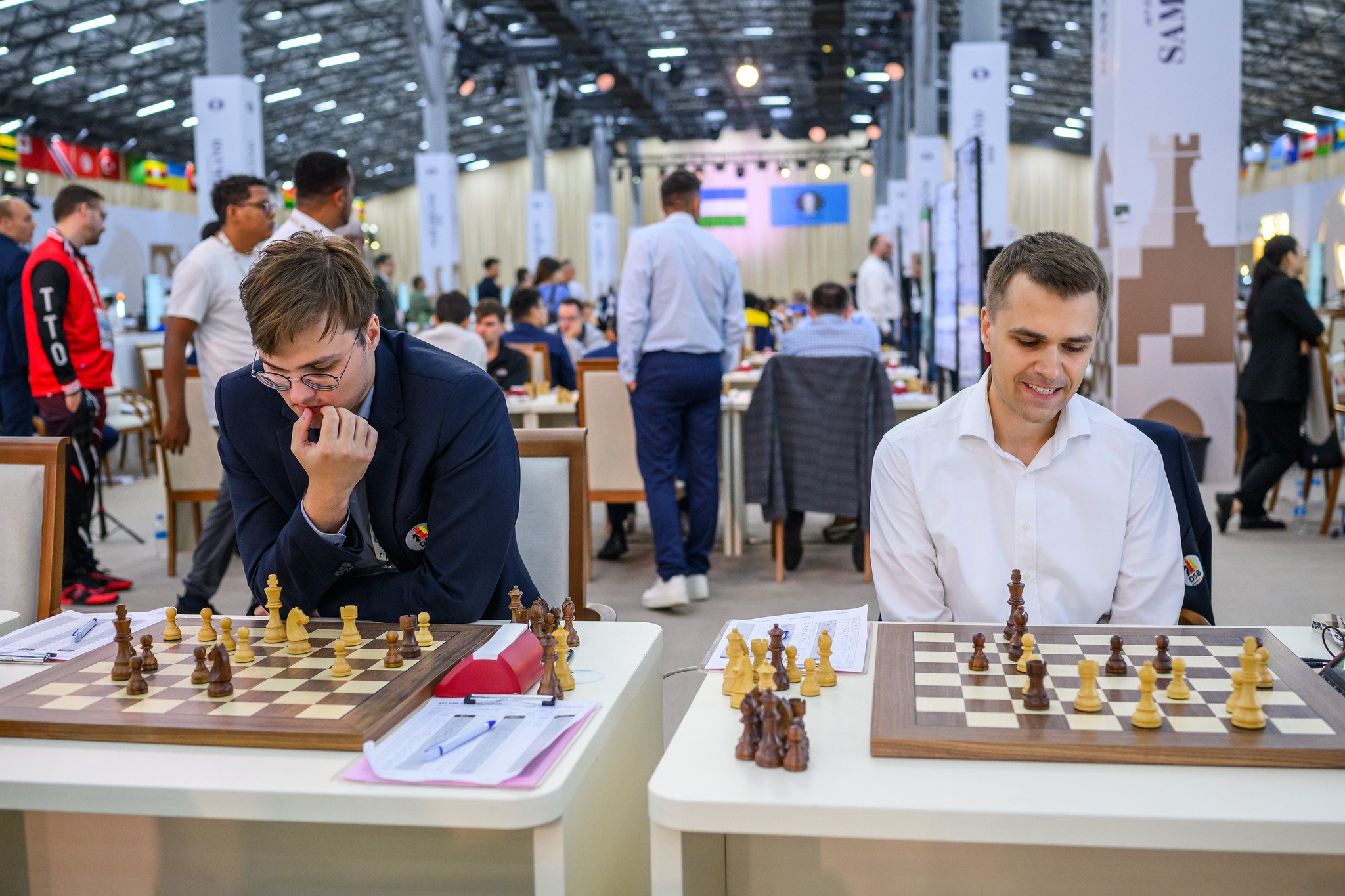
The Netherlands beat Bulgaria with the massive score of 3.5-0.5, with wins by GMs Anish Giri, Jorden van Foreest, and Loek van Wely against GMs Arkadij Naiditsch, Momchil Petkov, and Martin Petrov, respectively. But even the draw was an incredible fight, with GM Radoslav Dimitrov having four pawns for GM Casper Schoppen‘s extra rook and, ultimately, saving the game with an underpromotion to a knight. A truly study-like draw!
Azerbaijan defeated Greece 3.5-0.5 as well, while Uzbekistan 2 and France made a draw (the host nation is allowed to host three teams). GM Jakhongir Vakhidov had a winning advantage against GM Maxime Vachier-Lagrave on board one, but so did GM Jules Moussard against GM Ortik Nigmatov on board four. All four games ended in draws.
Germany will have its chance to stop the Uzbek juggernaut, while the four teams on 12 points battle it out as well: India vs. Azerbaijan and the Netherlands vs. Armenia.
Round 8 Pairings: Top 10 Open
| No. | Seed | Fed | Team | Pts. | MP | Res. | : | Res. | MP | Pts. | Team | Fed | Seed |
| 1 | 5 | Germany | 19 | 12 | : | 14 | 22½ | Uzbekistan *) | 3 | ||||
| 2 | 2 | India | 18½ | 12 | : | 12 | 20 | Azerbaijan | 7 | ||||
| 3 | 6 | Netherlands | 19½ | 12 | : | 12 | 19 | Armenia | 10 | ||||
| 4 | 1 | United States of America | 18 | 11 | : | 11 | 18½ | Serbia | 15 | ||||
| 5 | 4 | China | 19½ | 11 | : | 11 | 19½ | Poland | 16 | ||||
| 6 | 20 | Czech Republic | 19 | 11 | : | 11 | 14½ | Hungary | 8 | ||||
| 7 | 9 | France | 19½ | 11 | : | 11 | 20½ | Iran | 18 | ||||
| 8 | 11 | England | 18 | 10 | : | 11 | 18 | Uzbekistan 2 | 30 | ||||
| 9 | 12 | Ukraine | 18½ | 10 | : | 10 | 19½ | Belarus | 39 | ||||
| 10 | 40 | Montenegro | 18 | 10 | : | 10 | 19 | Spain | 13 | ||||
Women: No Team Perfect As Medal Battle Heats Up
Except for the battle of the leaders, almost all the remaining matches at the top were decisive in round seven.
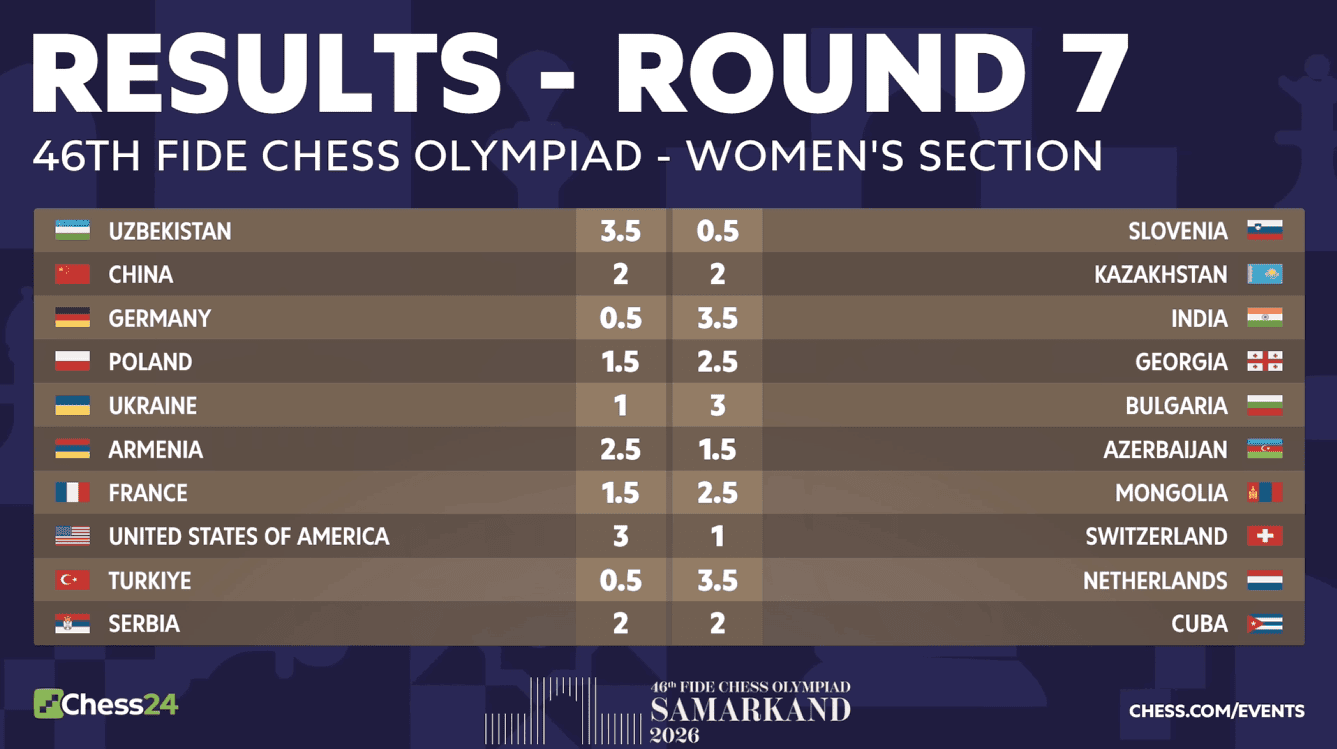
We still have two leaders, but their tie has allowed the chasing pack to move closer, with two points separating the top 11 teams.
Women’s Standings After Round 7: Top 20
| # | Seed | Fed | Team | Matches | + | = | – | Points | TB1 | TB2 |
| 1 | 4 | China | 7 | 6 | 1 | 0 | 13 | 187 | 22.5 | |
| 2 | 3 | Kazakhstan | 7 | 6 | 1 | 0 | 13 | 167.5 | 20.5 | |
| 3 | 1 | India | 7 | 6 | 0 | 1 | 12 | 185.5 | 22 | |
| 4 | 11 | Bulgaria | 7 | 6 | 0 | 1 | 12 | 172 | 22 | |
| 5 | 2 | Georgia | 7 | 5 | 2 | 0 | 12 | 162.5 | 20.5 | |
| 6 | 16 | Armenia | 7 | 6 | 0 | 1 | 12 | 156 | 20 | |
| 7 | 15 | Mongolia | 7 | 6 | 0 | 1 | 12 | 145 | 19 | |
| 8 | 5 | United States of America | 7 | 5 | 1 | 1 | 11 | 166 | 21 | |
| 9 | 13 | Uzbekistan | 7 | 5 | 1 | 1 | 11 | 151.5 | 20 | |
| 10 | 12 | Netherlands | 7 | 4 | 3 | 0 | 11 | 148 | 20 | |
| 11 | 24 | Greece | 7 | 5 | 1 | 1 | 11 | 124 | 18.5 | |
| 12 | 20 | England | 7 | 5 | 0 | 2 | 10 | 150 | 21.5 | |
| 13 | 8 | France | 7 | 5 | 0 | 2 | 10 | 148 | 20.5 | |
| 14 | 7 | Azerbaijan | 7 | 5 | 0 | 2 | 10 | 144.5 | 19 | |
| 15 | 9 | Poland | 7 | 5 | 0 | 2 | 10 | 143.5 | 18.5 | |
| 16 | 17 | Switzerland | 7 | 4 | 2 | 1 | 10 | 143 | 19 | |
| 17 | 10 | Germany | 7 | 5 | 0 | 2 | 10 | 142.5 | 17 | |
| 18 | 14 | Serbia | 7 | 4 | 2 | 1 | 10 | 140 | 19 | |
| 19 | 30 | Iran | 7 | 5 | 0 | 2 | 10 | 138 | 19 | |
| 20 | 39 | Peru | 7 | 5 | 0 | 2 | 10 | 137 | 19.5 |
All eyes in round seven were on the clash of the perfect teams, fourth seed China and third seed Kazakhstan. If one of them could break clear they might take some stopping, but instead the match ended in a draw.
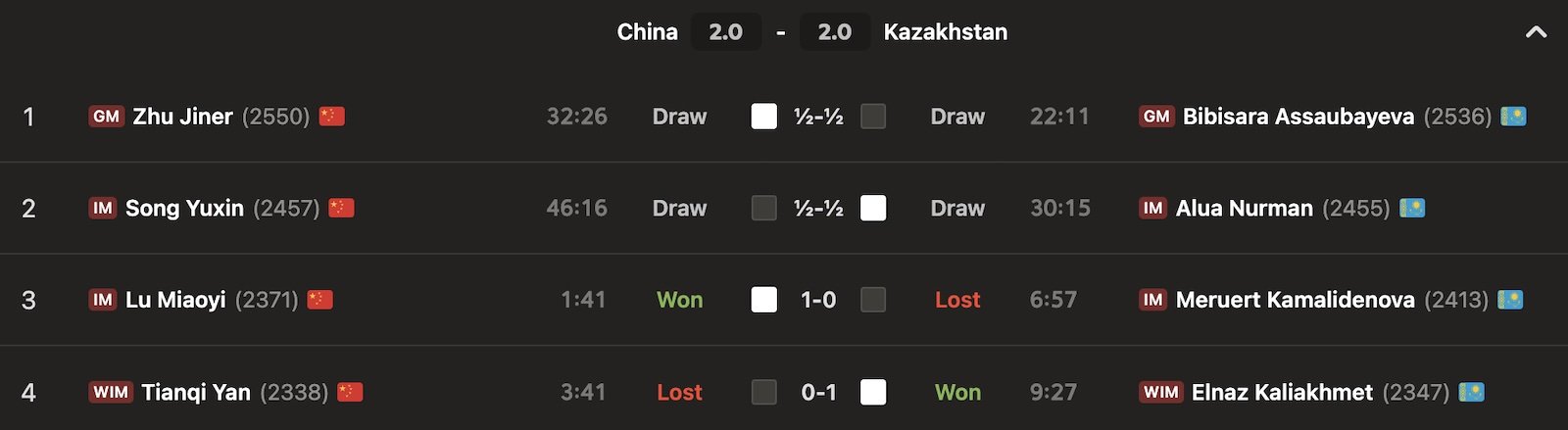
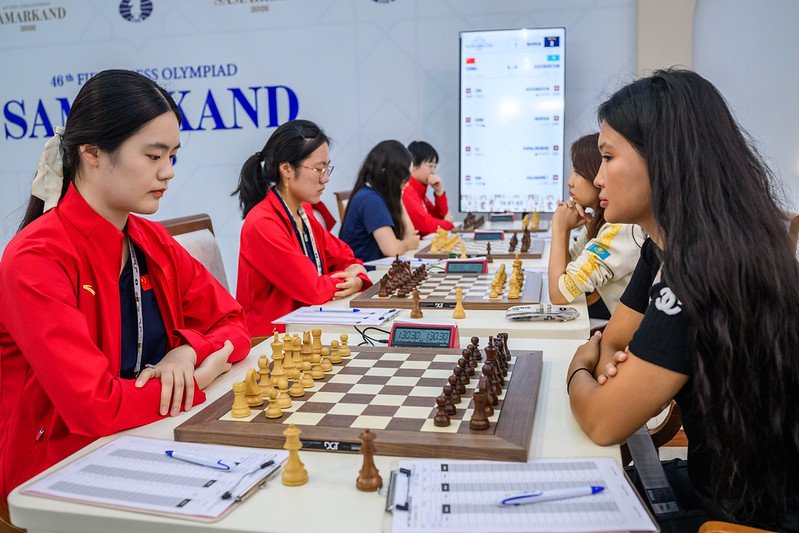
In the end it was an escape for China, which had looked in trouble ever since WIM Tianqi Yan went astray early on and allowed 16-year-old WIM Elnaz Kaliakhmet to launch a huge attack. The Chinese star tried to hold on, but couldn’t avoid the Chinese women’s first loss of a single game at the Samarkand Olympiad.
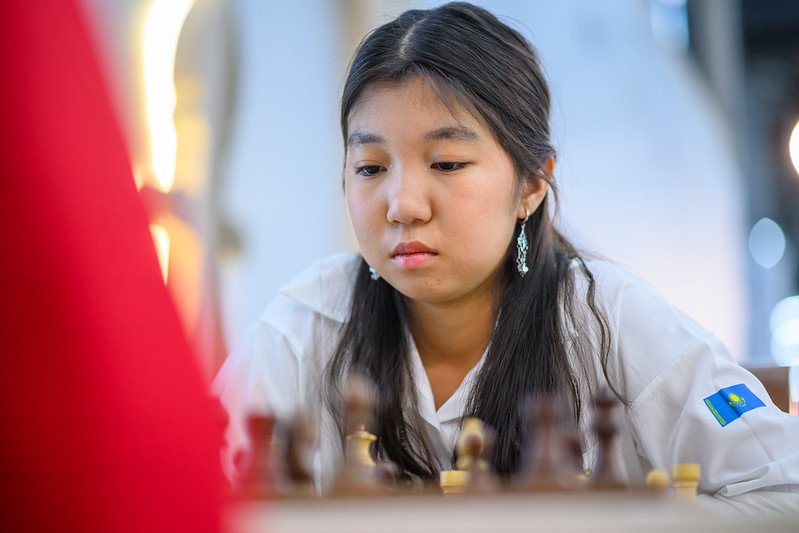
Another 16-year-old hit back for China, however, in equally brilliant style, with IM Lu Miaoyi moving to 6/7 with a win over IM Meruert Kamalidenova.
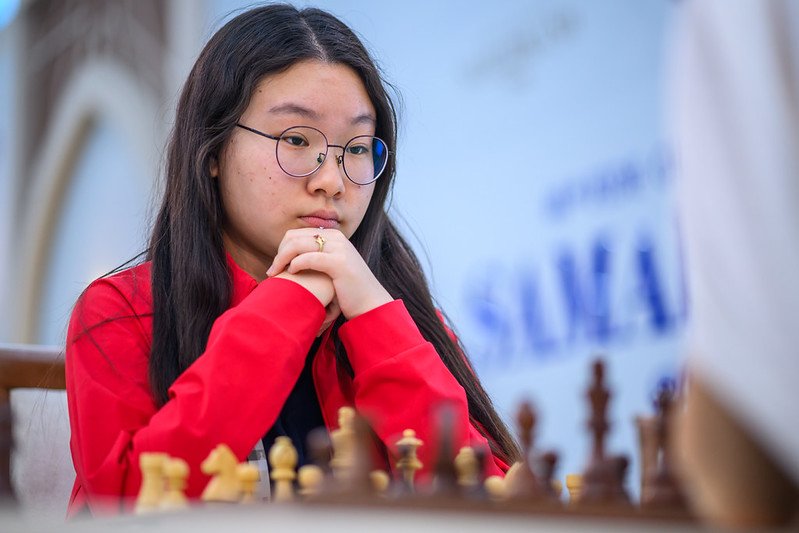
It looked like IM Alua Nurman might be the match-winner for a second day in a row after spotting an endgame win, but this time it slipped through her fingers against IM Song Yuxin, who moved to 5/6.
That tie at the top was great news for all the other medal hopefuls, including the first (India), second (Georgia), and fifth seeds (U.S.), who all won. India continued its recovery from the loss to Poland with a 3.5-0.5 demolition of Germany, led by GM Divya Deshmukh, who suddenly took complete control after WGM Hanna Klek made a couple of natural-looking moves.
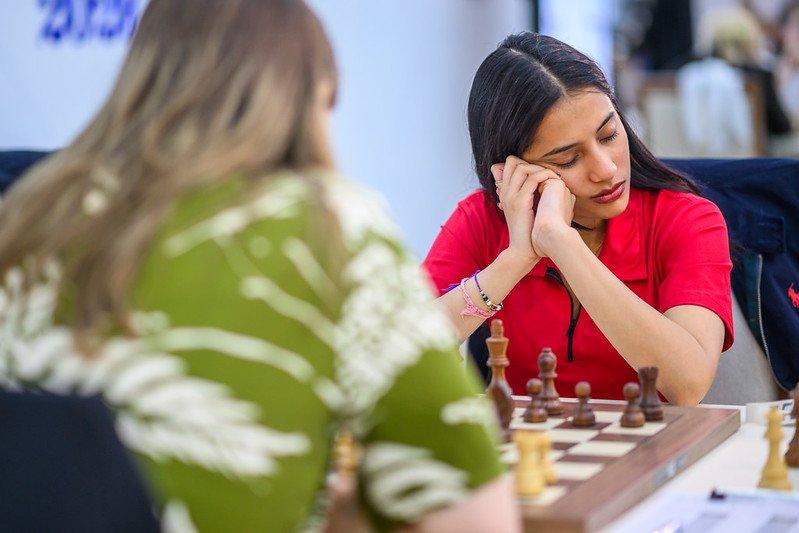
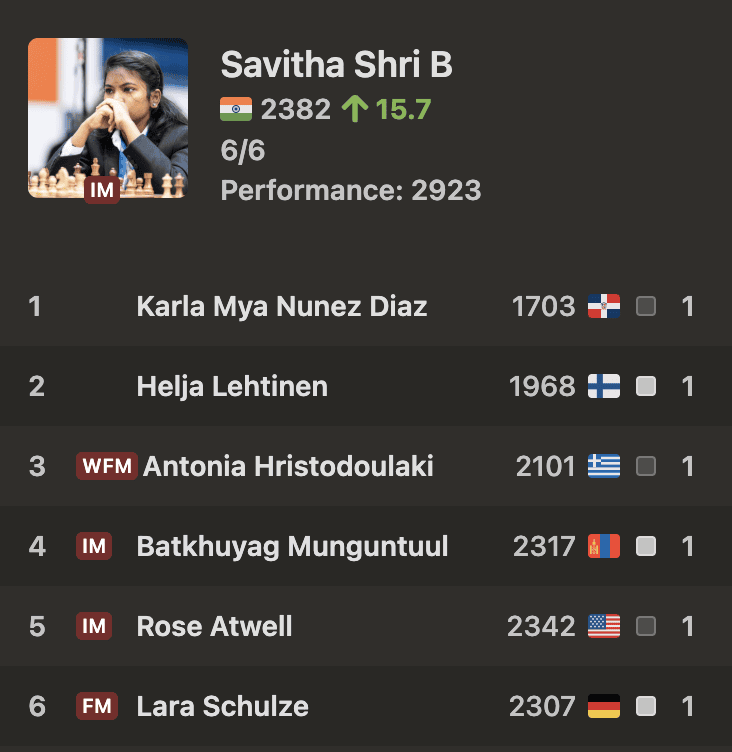
GM Koneru Humpy gradually took over and won with Black on top board, while IM Savitha Shri put the icing on the cake by winning an endgame she’d started a pawn down to move to a perfect 6/6.
India is just one point behind the leaders, along with Georgia, which dropped two match draws earlier in the event but is yet to lose a match. The team narrowly defeated Poland 2.5-1.5 in round seven, despite IM Oliwia Kiolbasa beating GM Nana Dzagnidze on top board.
GM Nino Batsiashvili smoothly outplayed IM Aleksandra Maltsevskaya, while the final blow was delivered by IM Lela Javakhishvili grinding out a win against IM Klaudia Kulon in an endgame she started a pawn down.
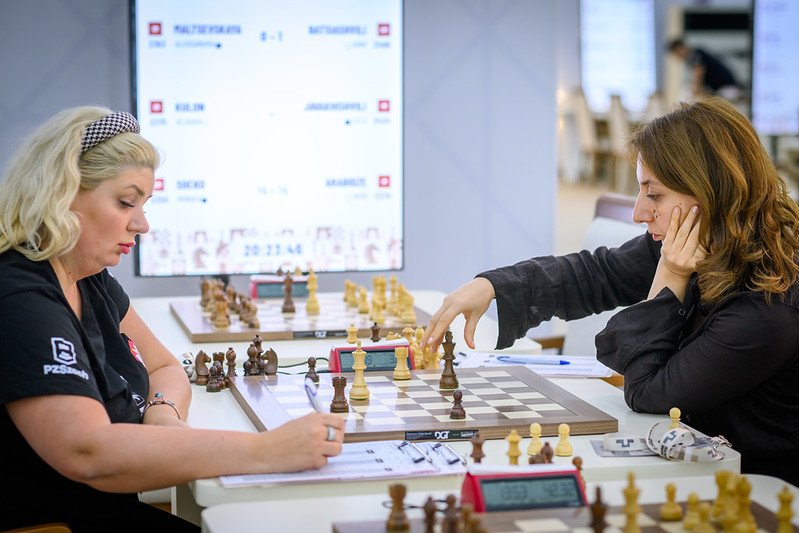
Three underdogs joined the teams on 12 points. 11th seed Bulgaria had been gifted a 4-0 win by Israel not showing up for round six, but in round seven showed they could win on their own by defeating sixth seed Ukraine 3-1. The key moment was a slip by WIM Anastasiya Rakhmangulova against WGM Beloslava Krasteva.
Tetyana Skarbarchuk on bottom board could have survived with another move just before she had to resign, but it wouldn’t have saved the match.
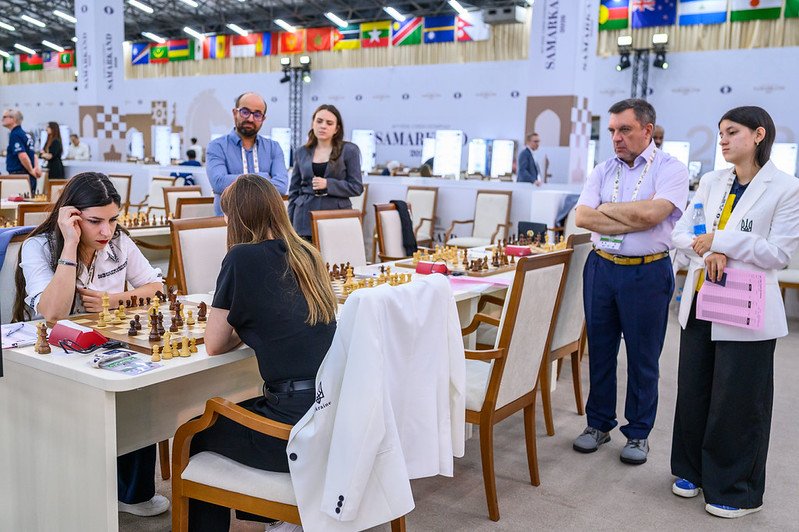
16th seed Armenia beat their great rivals and seventh-seeded Azerbaijan 2.5-1.5, with powerful wins with the white pieces for veterans IM Lilit Mkrtchian and GM Elina Danielian.
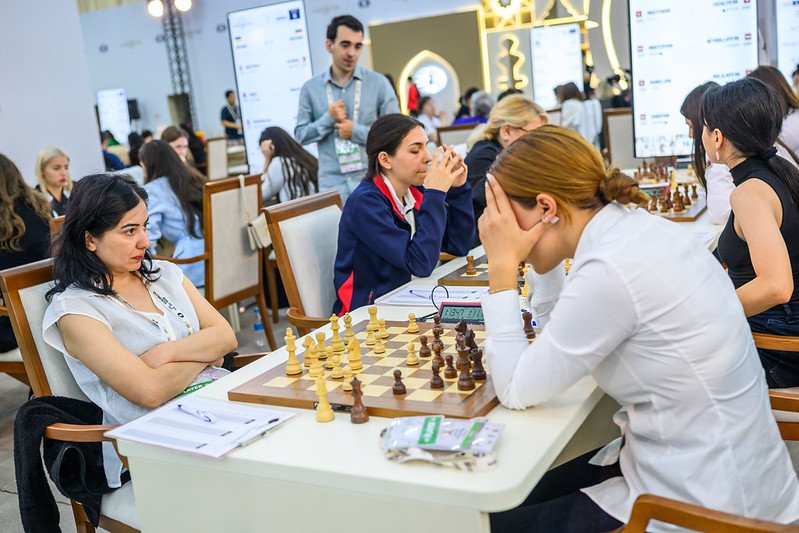
15th seed Mongolia beat eighth seed France—with a single win on the board where France had the biggest rating advantage, the game between seven-time French Women’s Champion IM Sophie Milliet and WCM Khishigbaatar Bayasgalan. 34…Qe6!! was inspired, even if there was a defense.
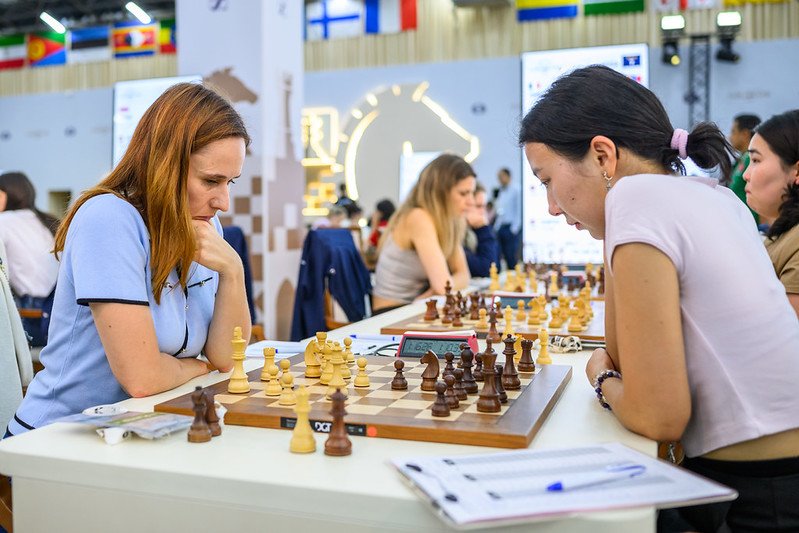
The teams another match point back are also well in contention. Those include the Netherlands, Greece, and hosts Uzbekistan, who defeated Slovenia 3.5-0.5, with 17-year-old WGM Afruza Khamdamova beating IM Laura Unuk on top board. Khamdamova called it “a benefit and a joy” that there was so much attention to the host nation.
Afruza Khamdamova after hosts Uzbekistan beat Slovenia 3.5-0.5 today, talking about the media attention: “I’ve been so happy and pressured at the same time!” #ChessOlympiad pic.twitter.com/NYbBrfsDo8
— chess24 (@chess24com) September 23, 2026
Those teams are joined on 11 points by the U.S., which followed a draw and a loss with a 3-1 win over Switzerland. The wins were picked up by IM Tatev Abrahamyan and IM Carissa Yip, who won a wild game against GM Alexandra Kosteniuk.
Carissa Yip on beating Alexandra Kosteniuk as the US defeated Switzerland 3-1 today: “I definitely felt I was cooking & then I kind of lost the heat for a second, so then I was pretty sad… but then I started cooking again!” pic.twitter.com/WjRrF35rLa
— chess24 (@chess24com) September 23, 2026
“I think in Budapest we lost one match and drew three, and then we got bronze, so we’re still in the running for the medals,” said Yip, while also explaining her attempt to inspire the U.S. Open team before the games began:
Awonder is my best friend in chess, so I had to give him a little good luck. And then I was like, you know what, it’s kind of rude if I don’t say good luck to Hans, because he’s kind of a homeboy, so I’m like good luck, Hans, and then I was like, it would be really mean to skip Fabi, so I give him a little pat too, and everyone got a pat!
You can see that on video in the interview above.
Meanwhile, in round eight, the U.S. team faces Armenia, but the main focus will be the clash of the top-four seeds. Kazakhstan takes on India, while China plays Georgia. If those heavyweight clashes are tied, underdogs Bulgaria and Mongolia have a chance to hit the top of the standings.
Round 8 Pairings: Women’s Top 10
| # | Seed | Fed | Team | Pts | MP | Res | : | Res | MP | Pts | Team | Fed | Seed |
| 1 | 12 | Netherlands | 20 | 11 | : | 11 | 20 | Uzbekistan *) | 13 | ||||
| 2 | 3 | Kazakhstan | 20½ | 13 | : | 12 | 22 | India | 1 | ||||
| 3 | 2 | Georgia | 20½ | 12 | : | 13 | 22½ | China | 4 | ||||
| 4 | 11 | Bulgaria | 22 | 12 | : | 12 | 19 | Mongolia | 15 | ||||
| 5 | 16 | Armenia | 20 | 12 | : | 11 | 21 | United States of America | 5 | ||||
| 6 | 24 | Greece | 18½ | 11 | : | 10 | 17½ | Ukraine | 6 | ||||
| 7 | 7 | Azerbaijan | 19 | 10 | : | 10 | 19 | Argentina | 28 | ||||
| 8 | 33 | Italy | 17 | 10 | : | 10 | 20½ | France | 8 | ||||
| 9 | 30 | Iran | 19 | 10 | : | 10 | 18½ | Poland | 9 | ||||
| 10 | 10 | Germany | 17 | 10 | : | 10 | 17½ | Austria | 34 |
Colin McGourty contributed to this report.
The 46th FIDE Chess Olympiad is a massive team event for national federations that takes place every two years. In 2026 it’s being held in Samarkand, Uzbekistan, with 11 rounds that run September 16-27. In Open and Women’s sections, teams of five players compete in a Swiss system, with each match played over four boards. There are two match points for a win and one for a draw, with board points taken into account only if teams are tied. Players have 90 minutes per game, plus 30 minutes from move 40, with a 30-second increment per move.
Previous coverage: