Schwarzman Scholars 2027: Fees, Eligibility & Deadline

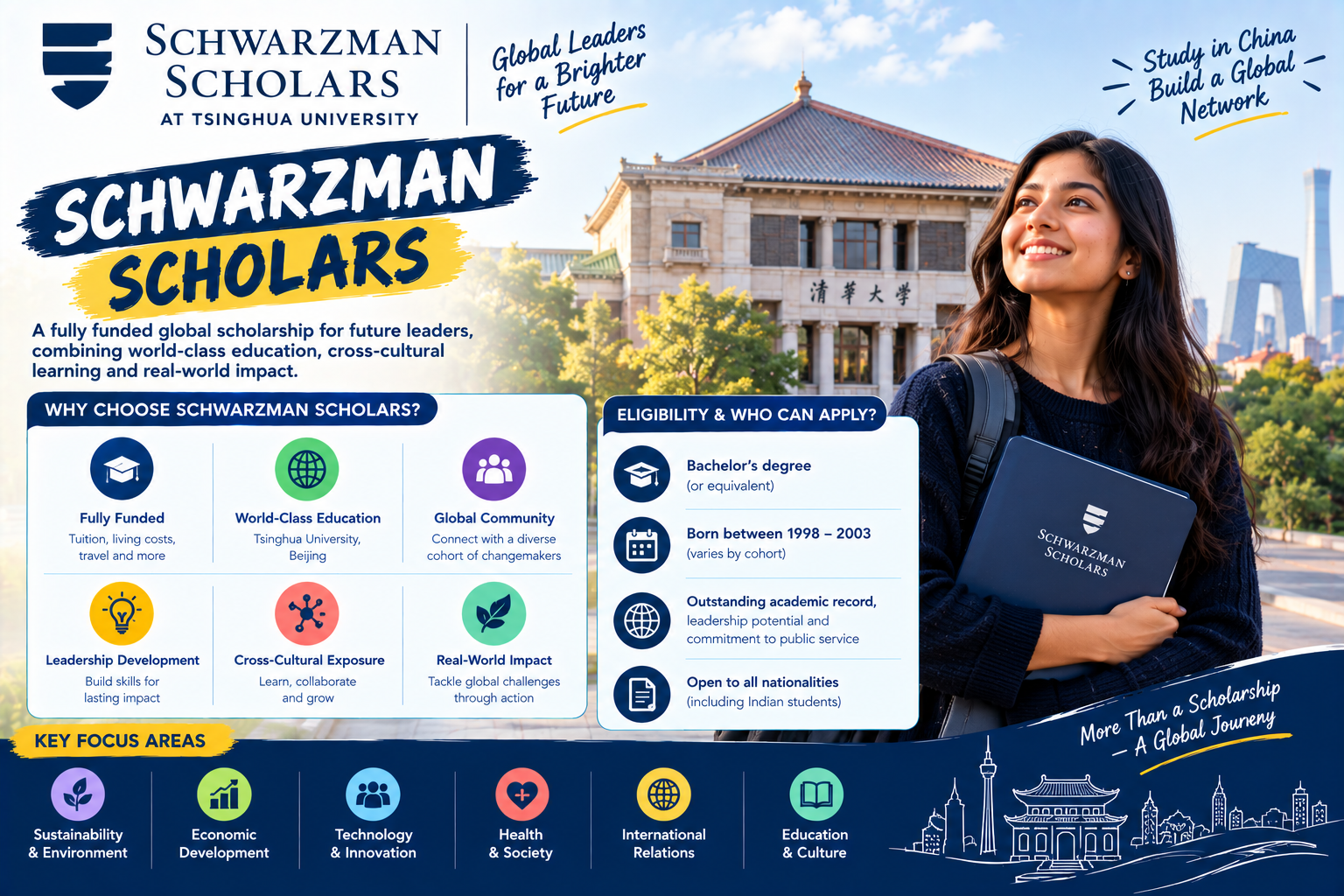
- Schwarzman Scholars funds a 1-year Master’s in Global Affairs at Tsinghua University, Beijing.
- Indian applicants use the Global track; the next deadline is expected around September 2027 for the Class of 2028-2029.
- The scholarship covers tuition and housing plus a Rs.3.6-4.75 lakh ($4,000-5,000) personal stipend.
- Around 150 scholars are chosen from 5,000+ applicants worldwide, so the acceptance rate stays near 3-4%.
What Is Schwarzman Scholars
Schwarzman Scholars is a fully funded, one-year Master’s program in Global Affairs at Tsinghua University in Beijing. Business leader Stephen A. Schwarzman established the program in 2016 to build a network of future leaders who understand China’s role in the world, modeling it loosely on the Rhodes Scholarship.
Every cohort studies together at Schwarzman College, a residential campus built specifically for the program, and picks one of three concentrations: Public Policy, Economics and Business, or International Studies. All teaching happens in English, so scholars do not need Mandarin to apply or to study.
For an Indian student, the Schwarzman Scholars program is one of the few scholarships that combines a top-ranked Asian university, a genuinely global cohort, and complete funding without asking for a specific undergraduate major.
Schwarzman Scholars Eligibility for Indian Students
Schwarzman Scholars eligibility is deliberately broad on paper, even though the program is extremely competitive in practice. To meet the basic Schwarzman Scholars requirements, you need to:
- Hold a bachelor’s degree, or be on track to finish all degree requirements before August 1 of your enrollment year
- Be at least 18 but not yet 29 years old as of August 1 of your enrollment year (for the Class of 2028-2029, that means born between August 2, 1999, and August 1, 2010)
- Demonstrate strong English proficiency through a recognized test score, unless your undergraduate or master’s instruction was in English for two years or more
- Come from any nationality and any undergraduate discipline, since Schwarzman Scholars does not restrict eligibility by field of study
There is no official minimum GPA. That said, the median GPA among successful applicants has hovered around 3.8 on a 4.0 scale, so a strong, consistent academic record still matters even without a firm cutoff.
Counselor insight: Students often self-reject over the GPA question. If your transcript shows an upward trend and you can point to leadership outside the classroom, a 3.4-3.6 GPA background from an Indian university is not automatically disqualifying. What tanks applications is a generic leadership narrative that could belong to any scholarship, not a middling grade sheet.
What Schwarzman Scholars Covers: Cost Table
Because the program is fully funded, an Indian applicant does not budget for tuition or rent the way they would for a self-financed Master’s. The table below breaks down what the scholarship actually pays for, with INR shown first.
| Component | Value in INR | Value in USD | Notes |
| Tuition and academic fees | Rs.0 | $0 | Fully waived by the program |
| Room and board at Schwarzman College | Rs.0 | $0 | On-campus housing included for the full year |
| Round-trip travel to Beijing | Rs.0 | $0 | Economy airfare covered at the start and end of the program |
| Health insurance | Rs.0 | $0 | Comprehensive cover for the program duration |
| Personal stipend | Rs.3.6-4.75 lakh | $4,000-5,000 | figures vary across recent sources; confirm the exact stipend for the Class of 2028-2029 on the official Schwarzman Scholars site before this goes live |
| Course materials and laptop | Rs.0 | $0 | Provided to each scholar |
At Rs.95 per USD (verify the live rate before publishing, since USD-INR has ranged between roughly Rs.86 and Rs.97 over the past year), the personal stipend alone works out to more than what many Indian students spend monthly on rent and food in a metro city, on top of a scholarship that already pays for tuition and housing.
Schwarzman Scholars Application Deadline and Timeline
The Schwarzman Scholars application deadline depends on your passport, and Indian applicants fall under the Global track, not the China track. The Global-track window for the Class of 2027-2028 has already closed, so the next opportunity for Indian applicants is the Class of 2028-2029 cycle.
- Global/US applicants (this includes India): Applications typically open around mid-April and close in early-to-mid September; the exact 2027 deadline for the Class of 2028-2029 had not been published as of this writing, so confirm the precise date on the official Schwarzman Scholars site closer to April 2027.
- Applicants with a Mainland China, Hong Kong, Taiwan, or Macao passport: A separate, earlier deadline applies, expected around May 2027 for the same Class of 2028-2029 cycle.
- Interview stage: Shortlisted candidates are invited to regional interviews, usually held in Beijing, London, and New York, with travel costs covered by the program.
- Final decisions: Results are typically announced by December, ahead of enrollment in August 2028.
Counselor insight: A common mistake among Indian applicants is treating the September deadline as flexible because it “feels far away” when applications open in April. In reality, strong recommendation letters and a polished personal essay take most students six to eight weeks to finalize, so it’s worth starting your Schwarzman Scholars application materials well before the portal even opens for the Class of 2028-2029, rather than waiting for the exact date.
Essays, Interviews, and Selection Odds
The application form asks for academic transcripts, English proficiency scores where applicable, a resume, letters of recommendation, and a set of personal essays that explain your leadership record and your reason for wanting to study China’s global role specifically.
Roughly 150 scholars are selected each year out of an applicant pool that regularly exceeds 5,000 candidates, which puts the effective acceptance rate at around 3-4%. That is how competitive Schwarzman Scholars actually is in practice, even though the written eligibility bar stays low. Around 300 candidates typically make it to the interview stage worldwide, so simply reaching an interview is itself a strong signal.
Selection panels weigh three things most heavily: demonstrated leadership (not just titles, but outcomes you can describe concretely), academic excellence, and a genuine, specific rationale for why this particular program, rather than a generic “study abroad” ambition, fits your goals.
Schwarzman Scholars vs Rhodes vs Fulbright
Indian students preparing prestigious scholarship applications often shortlist Schwarzman Scholars alongside the Rhodes Scholarship and the Fulbright-Nehru fellowships. Each serves a different purpose, so the right pick depends on what you want out of the year.
| Factor | Schwarzman Scholars | Rhodes Scholarship | Fulbright-Nehru |
| Host location | Tsinghua University, Beijing | University of Oxford, UK | Various US universities |
| Duration | 1 year | 2-3 years | Typically 1-2 years |
| Field | Global Affairs (3 concentrations) | Open, subject to Oxford’s offerings | Open, subject to US program |
| Minimum GPA | None stated | High academic bar, no fixed cutoff | Programme-dependent |
| Funding | Fully funded plus stipend | Fully funded plus stipend | Fully funded, terms vary by award |
If your goal is a shorter, China-focused leadership credential you can complete in a single year, Schwarzman Scholars is the more direct route. If you are set on the UK and a longer academic runway, the Rhodes Scholarship for India is worth comparing in detail. Students weighing a US-based alternative should also look at the Fulbright Scholarship India program before deciding.
Counselor insight: Most students researching Schwarzman Scholars look at it in isolation and only discover Rhodes or Fulbright-Nehru later, once they’ve already sunk weeks into one application. Laying the three out side by side early, the way the table above does, is what actually helps you pick a country and duration you won’t second-guess in October.
Are Schwarzman Scholars Worth It From India
For most Indian applicants, whether Schwarzman Scholars is worth it depends on your career direction rather than a generic yes or no. It is worth pursuing if you want exposure to China’s economy and policy landscape, a genuinely international cohort, and a fully funded credential that does not tie you down for more than a year. It is a weaker fit if your career plan depends heavily on staying in a specific country’s job market immediately after graduation, since the program does not include a China work visa or automatic post-study work rights.
Because Tsinghua University sits inside China’s broader higher education system, it also helps to understand what studying in China involves day to day, from the campus culture at Schwarzman College to how coursework is structured, before you commit a full application cycle to it.
Counselor insight: Applicants set on staying in China immediately after graduation often assume Schwarzman Scholars opens that door directly. It doesn’t come with a work visa sponsorship, so pair it with a separate post-study plan if staying on in China, rather than the scholarship itself, is your actual goal.
3 Takeaways on Schwarzman Scholars
- Confirm you meet the core Schwarzman Scholars eligibility bar (age 18-28, bachelor’s degree, English proficiency) before investing time in essays, since none of these three requirements has flexibility.
- Track the Global-track deadline for the Class of 2028-2029 (expected around September 2027) if you hold an Indian passport, since the prior cycle’s September 2026 deadline has already closed, and start your recommendation letters at least two months before it opens.
- Decide early whether Schwarzman Scholars, Rhodes, or Fulbright-Nehru matches your career goals, because each pulls you toward a different country, duration, and post-program path.
Ready to figure out where Schwarzman Scholars fits into your study-abroad plan? Talk to a LeapScholar counselor and get a clear-eyed view of your Schwarzman Scholars profile before you commit an application cycle to it.
Frequently Asked Questions About Schwarzman Scholars
-
Is Schwarzman Scholars prestigious?
Schwarzman Scholars ranks among the most selective global fellowships, often mentioned alongside Rhodes and Marshall. A single-digit acceptance rate and Stephen Schwarzman’s $1 billion endowment behind the program give it real weight on a resume.
-
Who is eligible for the Schwarzman Scholarship?
Applicants need a bachelor’s degree, must be 18 to 28 years old as of August 1 of their enrollment year, and should show strong English skills. There’s no restriction on nationality or undergraduate major.
-
Are there Schwarzman Scholars in India?
Indian students get selected every year, though the program doesn’t publish a fixed country quota. Numbers vary by cohort based purely on how strong that year’s Indian applications turn out to be.
-
How much is the monthly stipend for the Schwarzman Scholarship?
The stipend isn’t paid monthly; scholars receive a lump personal allowance of roughly $4,000 to $5,000 for the full year, on top of tuition, housing, and travel. Confirm the exact current figure on the official site.
-
What is the average GPA for Schwarzman Scholars?
There’s no official minimum GPA, but the median among admitted scholars sits close to 3.8 out of 4.0. Strong academics still matter even without a hard cutoff on paper.
-
What are the benefits of being a Schwarzman scholar?
Scholars receive full tuition, housing at Schwarzman College, return flights to Beijing, health insurance, course materials, and a personal stipend. They also gain a global alumni network and direct mentoring from world leaders.
-
How many Schwarzman Scholars are selected?
Around 150 scholars are chosen each year from an applicant pool that regularly crosses 5,000, putting the effective acceptance rate near 3 to 4 percent.
-
How do I apply to Schwarzman Scholars?
Applications go through the official Schwarzman Scholars portal and include transcripts, a resume, recommendation letters, and personal essays. Shortlisted candidates then attend a regional interview before final selections are made.
-
How long are Schwarzman Scholars?
The program runs for one full academic year, covering a Master’s in Global Affairs at Tsinghua University in Beijing.
-
Are Schwarzman Scholars worth it?
For students drawn to China’s global role, a genuinely international cohort and a fully funded one-year credential hold up well. It’s a weaker fit if your plans hinge on staying in China’s job market right after graduation.