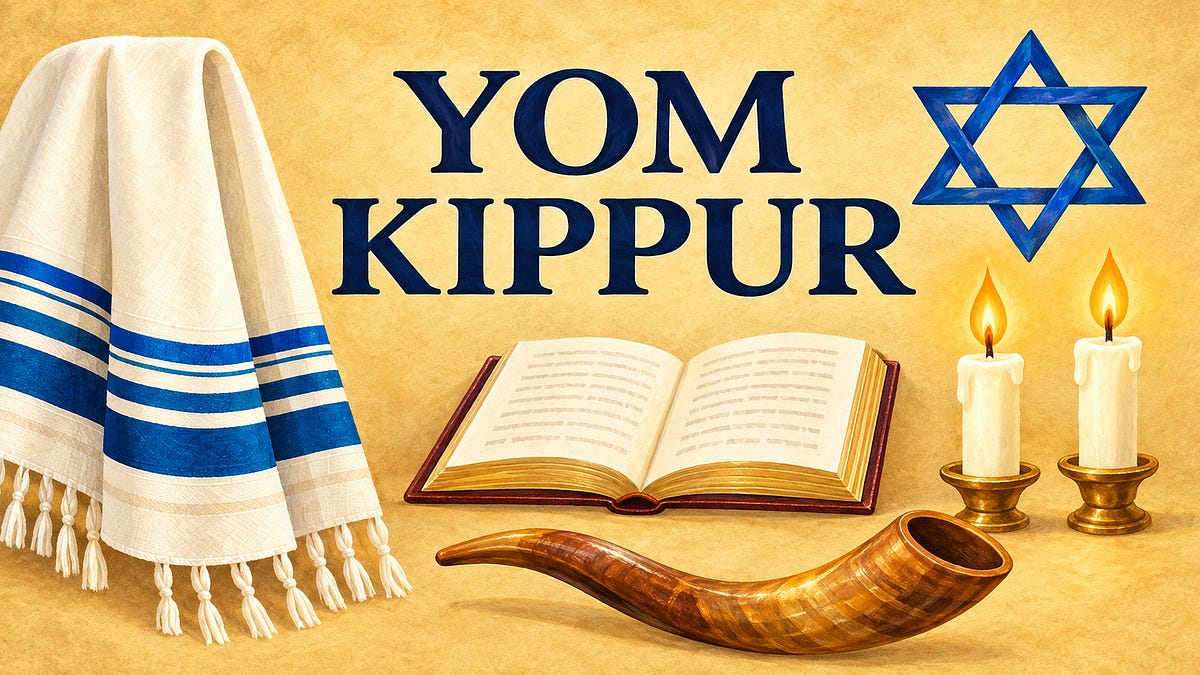

Beginning at sundown tonight, Yom Kippur, the Day of Atonement, concludes the Ten Days of Awe, which begin with Rosh Hashanah, the Jewish New Year.
Judaism’s holiest day arrives this year amid a war in which grief is used to justify further bloodshed. Israelis and Palestinians do not bear identical responsibility, but no moral reckoning that recognizes only one people’s suffering can lead them out of catastrophe.
A holy day cannot end a war or raise the dead. It can break the spell of collective innocence. Yom Kippur’s central confession speaks in the first-person plural.
We have sinned.
That pronoun does not distribute guilt equally. It refuses to limit guilt to others. It asks what each person, community, and nation has done, permitted, excused, or refused to see. Amid competing memories of injury, Yom Kippur demands something harder than despair: truth, responsibility, and the possibility of return.
On Yom Kippur, Jews examine their lives through fasting, prayer, and confession. Tradition teaches that the day atones for wrongs against God, but not for wrongs against another person until one seeks forgiveness and makes amends. God’s judgment, opened on Rosh Hashanah, is traditionally sealed on Yom Kippur.
At the heart of Yom Kippur is teshuvah—repentance as return to God. No English word carries the Hebrew’s full range. Teshuvah means returning to God, to one’s deepest identity, and to a life redirected through recognition, confession, and repair.
Wrongdoing is personal but never private. It enters families, institutions, and nations. Atonement asks what can be repaired, whom we have refused to face, and which habits continue to injure others.
In conflict, each wound can justify the next. Atonement interrupts that pattern. It makes memory answerable for what comes next. In ordinary English, remembering can mean little more than recalling. Biblical remembrance carries the past into action. To observe Yom Kippur is to carry memory from mind to mouth, and finally to deed.
When we ask, Where is justice? Yom Kippur presses another question: Where is mercy? “We have sinned” leaves no one outside the need for forgiveness. Mercy does not erase guilt or excuse wrongdoing. It refuses to let guilt be the whole story. Where would any of us be without it?
Yom Kippur belongs to Israel’s covenant with God. Yet the Ten Days of Awe begin with a Torah reading that includes Ishmael—not the son through whom Israel traces the covenantal line, but Abraham’s child by Hagar, an enslaved Egyptian.
At Sarah’s insistence, Abraham sends Hagar and Ishmael into the wilderness with bread and a skin of water. When the water runs out, Hagar places her son beneath a shrub and moves away, unable to watch him die. Isaac will inherit the covenant. Ishmael appears to inherit only exile.
Then the story turns.
God hears Ishmael “where he is.” Resented and rejected.
God explicitly promises that Ishmael will also become a great nation. His name itself—meaning “God hears”—serves as a permanent marker of divine attention to his distress.
For Muslims, Ishmael is Isma‘il, a prophet and Abraham’s son. The Qur’an places him beside Abraham as they raise the foundations of the Kaaba, the sanctuary in Mecca toward which Muslims pray. Muslim tradition traces Muhammad’s ancestry through Ishmael; Isaac, Israel’s forefather, is his half-brother. In the biblical story, rejection drives Ishmael into the wilderness, but not beyond divine care.
God hears Ishmael. The question is whether we do.
That question does not settle borders, return hostages, remove settlements, defeat Hamas, or stop the killing in Gaza. It neither equalizes guilt nor erases history. It sets a limit on every political claim: the enemy’s child remains a child.
The test reaches life in America. At kitchen tables, in congregations, on school boards, and across party lines, people are reduced to a party, race, religion, grievance, or threat. The verdict comes before the person speaks, and listening feels like betrayal.
Yom Kippur is too serious for despair. Despair can become a final claim to innocence: nothing can change, so nothing can be asked of us. Vengeance offers another refuge: only the enemy must change. Both release us from the responsibility of repair.
Atonement removes that refuge. The past cannot be changed. What we do because of it can. God hears Ishmael before anyone rescues him. On Yom Kippur, the question is not whether God is listening.
It is whether we are—and what we will do once we hear.
Notes and reading
-
Rabbi Abraham Joshua Heschel (1907–1972), one of the twentieth century’s great Jewish theologians and moral witnesses, “Remarks on Yom Kippur” (August 1965), via The Open Siddur Project (September 24, 2023). Here, erev (the eve and hours leading into the holy day) underscores the labor of seeking face-to-face amends with others—a spiritual task whose weight often surpasses the formal liturgy and fasting of Yom Kippur itself.
-
Heschel wrote in The Prophets that while some are guilty, all are responsible. American Jews are not collectively guilty for Israel’s actions in Gaza. Responsibility begins elsewhere: in resisting what Heschel called “the evil of indifference” and refusing to look away from Palestinian suffering. That requires no denial of Jewish grief or solidarity, only an honest reckoning with what one has refused to see.
-
Rabbi Jonathan Sacks, Introduction to The Koren Sacks Yom Kippur Mahzor (Koren Publishers, 2012). Sacks (Chief Rabbi of the UK and Commonwealth, 1991–2013) writes: “Yom Kippur is a day of profound liberation. Atonement means that we can begin again. We are not held captive by the past or by our failures. The book is open, and God invites us to write a new chapter in the story of our people. It is a day on which God invites us to greatness.”
-
Elie Wiesel—Holocaust survivor, Nobel laureate, and ardent Zionist. Wiesel regarded Israel as a nonnegotiable safeguard against another Holocaust while acknowledging Palestinian suffering. His warning is universal: “Neutrality helps the oppressor, never the victim. Silence encourages the tormentor.” On Yom Kippur, those words permit no exemption from the suffering of civilians, especially children.— Elie Wiesel, Nobel Peace Prize acceptance speech, Oslo, December 10, 1986. The application of Wiesel’s words to Gaza is mine, though consistent with the universal moral responsibility he invoked.
-
“The mainstreaming of therapy culture may be driving us all out of our minds.” Steve Salerno, “Citizen Sane” (Quillette, September 18, 2026). Salerno describes a culture better at explaining feelings than changing conduct. Yom Kippur offers a bracing rejoinder: not every discomfort is trauma, feeling better is not the same as doing better, and confession is not a request for validation. The diagnosis is simpler: We have sinned. The treatment is repentance and repair.
Editorial note: I sometimes use AI-assisted tools for proofreading, clarification, and revision. The ideas, judgments, and final wording remain my own.