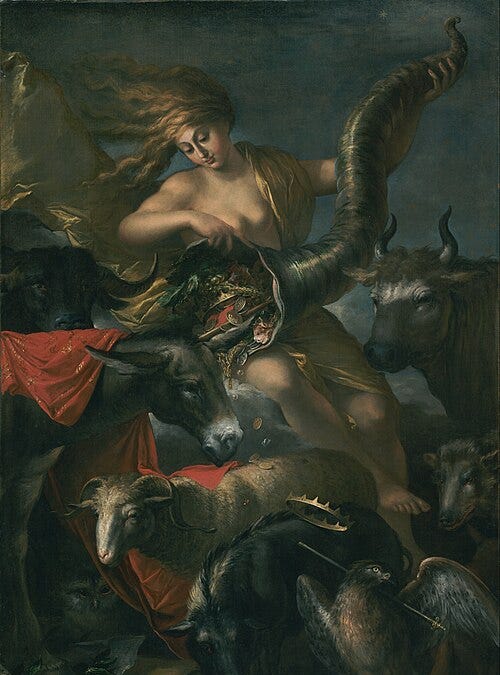
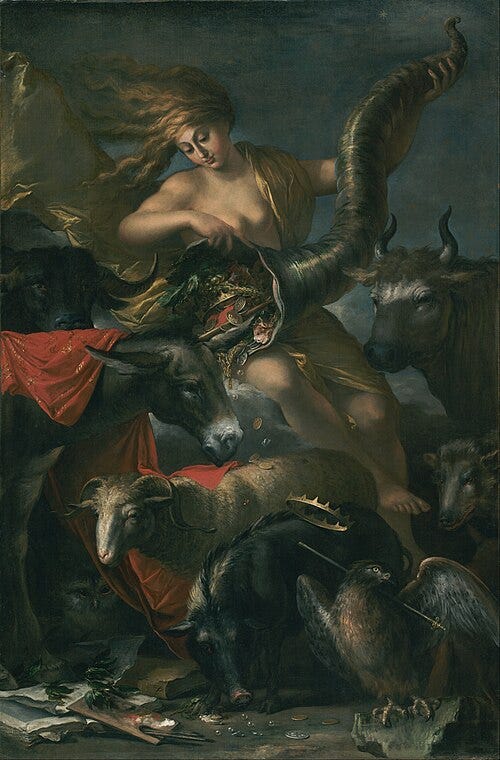
Bad luck builds character, especially when it happens to someone else.
Boethius, a sixth-century Roman statesman and philosopher, knew something about it. Dante placed him among the wise in Paradise. Chaucer and Queen Elizabeth I translated him. Aquinas drew upon his thought, and C. S. Lewis cherished The Consolation of Philosophy.
An impressive legacy for a man who wrote his masterpiece under a death sentence. At the height of his career, Boethius was accused of treason, stripped of office, imprisoned, and executed.
Misfortune sounds better in the abstract. “All things work together for good for those who love God.” Optimism drops the qualifying clause: “All things work together for good.” Bad luck is a blessing in disguise. Play the hand you are dealt.
Boethius offered no easy reassurance. His consolation neither denied suffering nor claimed that every loss improves its victim. Yet he did believe adverse fortune could instruct. It strips away the illusion of control and forces a harder question: What remains when circumstances no longer confirm who I thought I was?
A profession, reputation, income, health, or routine can become part of who we think we are without our noticing. When one disappears, its loss can feel like losing part of ourselves. Fortune’s hard lesson is that its gifts were always on loan.
Positive thinking is often Fortune in a motivational T-shirt, promising to restore what was lost if we smile enough. Christian faith, too, can be reduced to therapy. Boethius offers a sterner consolation. The point is not to feel better, call loss a blessing, find its silver lining, or feel grateful for a bad hand. It is to stop mistaking a favorable hand for a worthy life.
Ancient thought left more room for Fortune. Much of what shapes a life, the ancients knew, arrives unearned. Modern success prefers the language of merit. Winners call good fortune character. Losers are told to improve theirs.
Today the mantra is “You make your own luck,” usually spoken by someone who already had some. God gets mixed in. Grace becomes luck with a halo, and success passes for divine approval. Those dealt a losing hand are told to pray harder. Boethius reverses the judgment. Good fortune can conceal defects of character as readily as bad fortune exposes them.
Good fortune is providence when it favors us, privilege when it favors someone else.
Luck names blind chance; grace, divine gift. Yet both can name benefits neither earned nor controlled. Surviving a disaster by “pure luck” can feel like secular grace, bringing gratitude, survivor’s guilt, and the humbling recognition that life is received, not achieved.
But Boethius is not finally writing about luck. He is writing about freedom.
For him, happiness must rest in a good that Fortune can neither bestow nor withdraw. He lost his rank, wealth, liberty, and finally his life. Yet between ruin and death, he wrote a book that outlived his judges and their kingdom. Fortune could dismantle his life without deciding its meaning.
Shakespeare brings this insight to life in King Lear. Stripped of crown, shelter, and command, Lear finally sees those whom prosperity had hidden from him: “Expose thyself to feel what wretches feel.” The storm does not save him. It breaks down the walls his good fortune built. Forsaken by Fortune, the king discovers what he shares with everyone else.
Our storms arrive less theatrically. A diagnosis divides life into before and after. A marriage ends. Work that supplied purpose and standing disappears.
The adage “Those who have a why to live can bear with almost any how” wears thin when suffering calls the why itself into question. Loss then asks what prosperity allowed us to postpone: Who am I when the life that answered that question no longer exists?
No answer restores what was lost. Another life must be made from what remains. This is the security Boethius discovered after Fortune forsook him: not protection from loss, but freedom from mistaking what can be lost for the whole of who we are.
We grow accustomed to the Dark—
When Light is put away—
As when the Neighbor holds the Lamp
To witness her Good-bye—
A Moment—We uncertain step
For newness of the night—
Then fit our Vision to the Dark—
And meet the Road—erect—
And so of larger—Darknesses—
Those Evenings of the Brain—
When not a Moon disclose a sign—
Or Star—come out—within—
The Bravest—grope a little—
And sometimes hit a Tree
Directly in the Forehead—
But as they learn to see—
Either the Darkness alters—
Or something in the sight
Adjusts itself to Midnight—
And Life steps almost straight.
—Emily Dickinson
Notes and reading
Boethius (c. 477–524). Peter Abelard called him “the greatest philosopher of the Latins.” Edward Gibbon called the Consolation “a golden volume,” worthy of Plato or Cicero. The precise circumstances of Boethius’s condemnation remain disputed, but Theodoric, ruler of Italy, accused him of conspiring with Constantinople.
The Consolation of Philosophy. P. G. Walsh’s translation offers an accessible modern edition (Oxford World’s Classics, 1999). “All fortune is good fortune; for it either rewards, disciplines, amends, or punishes, and so is either useful or just.” Boethius does not mean that suffering is good in itself. Fortune’s apparent rule stands beneath divine providence, and no worldly outcome can determine a life’s goodness. Creation is good because whatever exists comes from God, though it is not God. Evil has no independent existence but is a deprivation of good. Tragedy itself is not thereby deserved or beneficial.
Howard R. Patch. The Goddess Fortuna in Mediaeval Literature (1927). Internet Archive. Still the classic study of Fortune’s development from a classical goddess into the medieval Lady Fortune. Patch traces how her wheel came to represent the instability of worldly goods and how Boethius placed her apparent rule beneath divine providence.
King Lear. Act 3, scene 4. Lear’s exposure to the storm strips away the protections of rank and awakens him to suffering he had previously ignored.
A why to live…and how. The adage paraphrases Friedrich Nietzsche’s Twilight of the Idols and was later popularized by Viktor Frankl in Man’s Search for Meaning.
Emily Dickinson. “We grow accustomed to the Dark—” (c. 1862; Franklin 428). Dickinson does not claim that darkness is good. She describes how people learn to move through a world they can no longer see as they once did.
Fortune in the Bible. Scripture rejects Fortune as a power to be served. Isaiah condemns those who “set a table for Fortune” and fill cups for Destiny (65:11). Yet Ecclesiastes observes that “time and chance happen to them all” (9:11), while Jesus refuses to treat catastrophe as proof of exceptional guilt (Luke 13:1–5). The Bible neither worships luck nor turns every outcome into a moral verdict.
Editorial note: I sometimes use AI-assisted tools for proofreading, clarification, and revision. The ideas, judgments, and final wording remain my own.