Subscribe to our ▶️ YouTube channel 🔴 for the latest videos, updates, and tips.
The Trigonometric Ratios Table shows the exact values of sin, cos, tan, cosec, sec, and cot for the standard angles 0°, 30°, 45°, 60°, and 90°. It is one of the most important reference tables in mathematics because it helps students solve trigonometry problems quickly without lengthy calculations. This table is widely used by students in middle school, high school, engineering, physics, and competitive examinations. Learning these values makes it easier to solve triangles, heights and distances, and many real-life applications of trigonometry.
Table of Contents:
What is Trigonometric Ratios Table?
What is Trigonometrical Ratios Table?
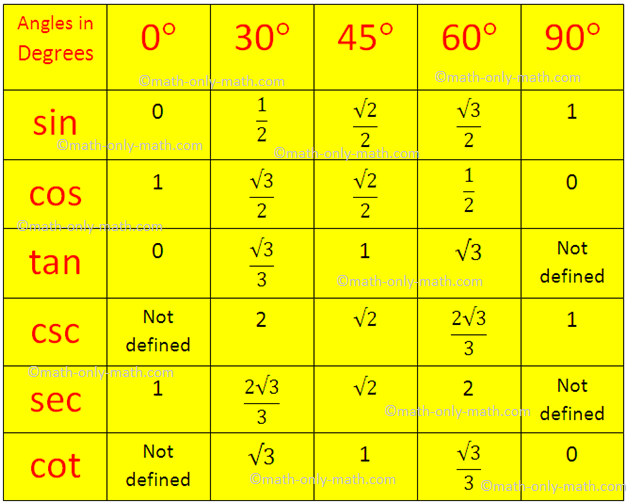
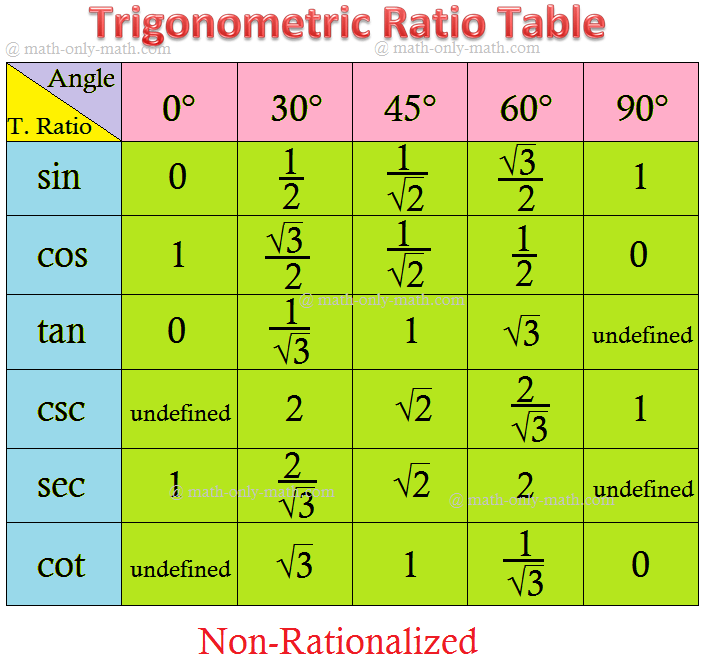
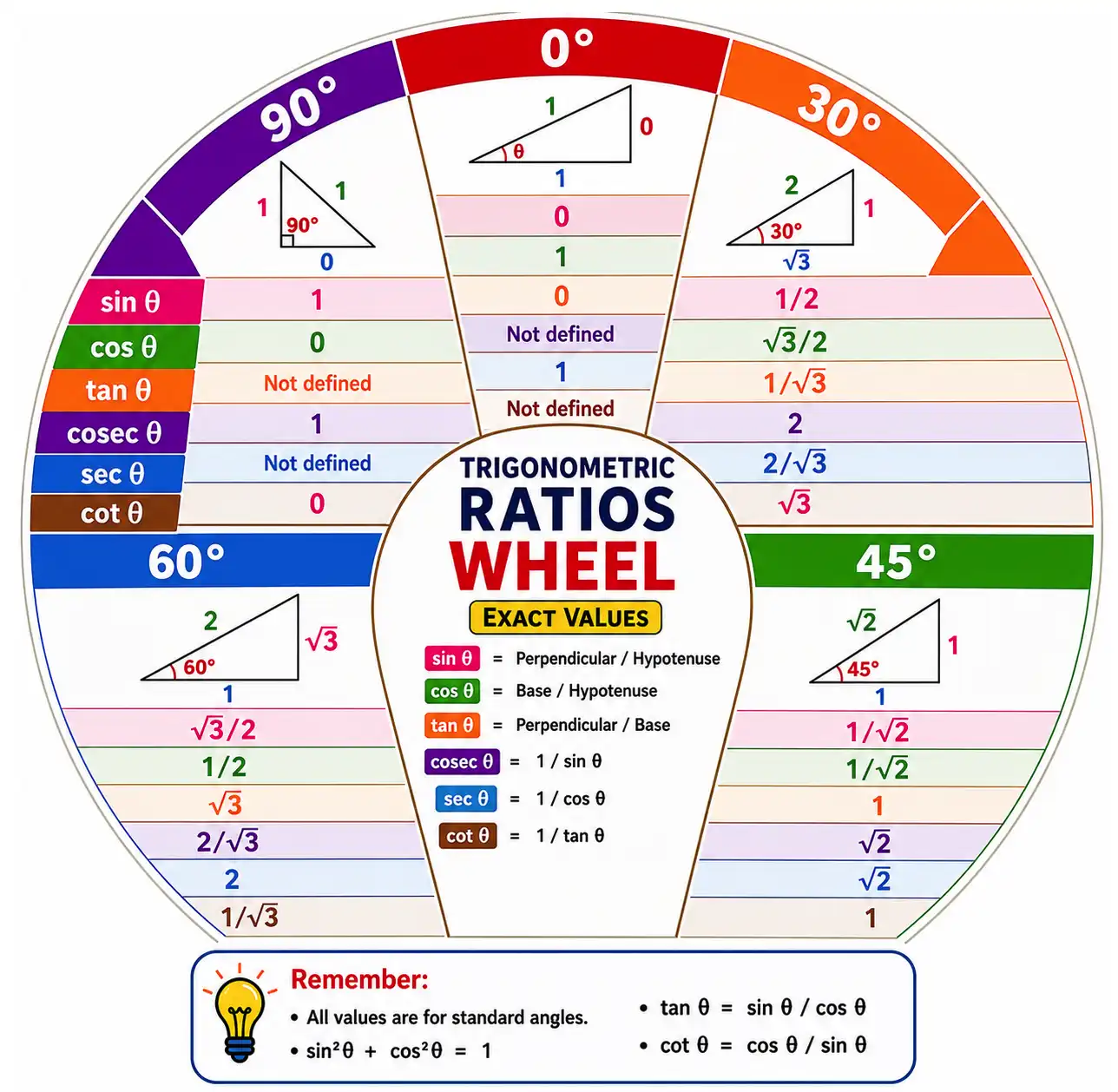
A trigonometrical ratios table shows the values of sin, cos, tan, cosec, sec, and cot for standard angles.
The standard angles
of trigonometrical ratios are 0°, 30°, 45°, 60° and 90°.
The values of trigonometrical ratios of standard angles are very important to solve the trigonometrical problems. Therefore, it is necessary to remember the value of the trigonometrical ratios of these standard angles. The sine, cosine and tangent of the standard angles are given below in the table.
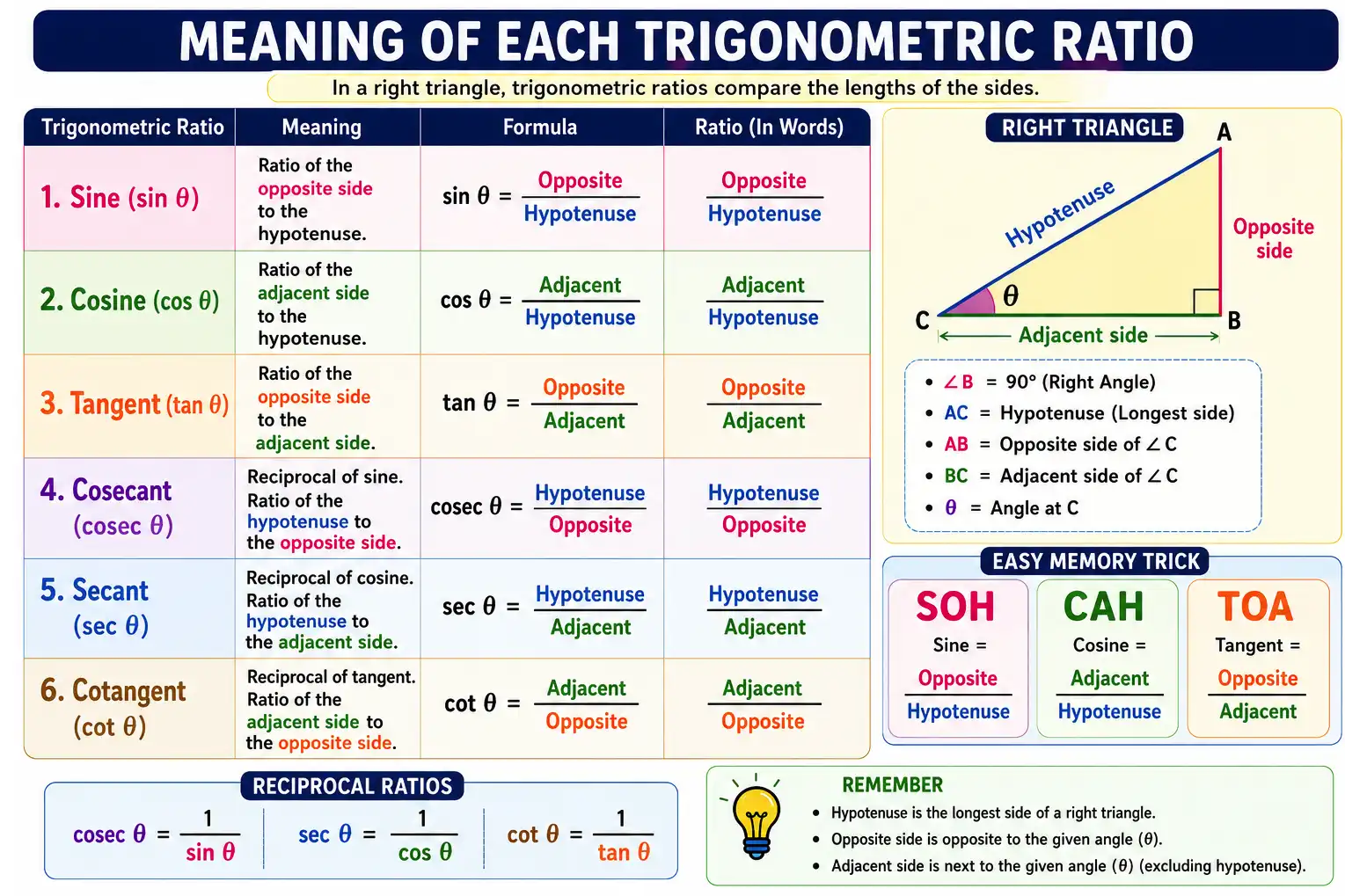
Meaning of Each Trigonometric Ratio:
In a right triangle, the six trigonometric ratios compare the lengths of the sides. These ratios help us find unknown sides and angles.
Trigonometric Table in Sexagesimal System:
#Free Download sin, cos, tan Table
#Free Download sin cos tan Chart
Trigonometric Table in Circular System:
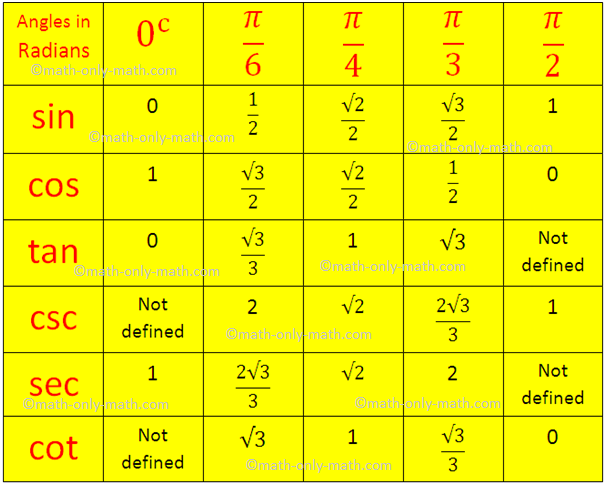
#Trigonometry Table Free Download
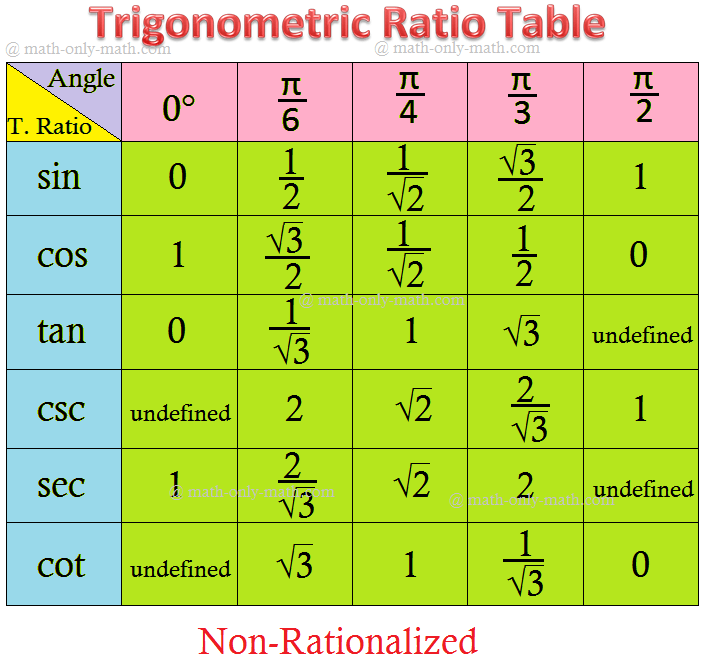
Free Download Trigonometric Ratios Table
Note: Values of sin θ and cos θ lies between 0 and 1 (both inclusive)
How to Read the Trigonometric Ratios Table?
Reading the trigonometric ratios table is simple. Follow these steps:
Step I: Choose the Angle
Look at the top row to find the required angle.
For Example: If the angle is 30°, go to the 30° column.
Step II: Choose the Trigonometric Ratio
Look at the left column to find the required trigonometric ratio.
The six ratios are:
- sin (Sine)
- cos (Cosine)
- tan (Tangent)
- csc (Cosecant)
- sec (Secant)
- cot (Cotangent)
Step III: Find the Value
The value is found where the row and column meet.
Examples:
Question |
How to Read? |
Answer |
|
What is sin 30°? |
Go to the sin row and the 30° column. |
\[ \frac{1}{2}\] |
|
What is cos 60°? |
Go to the cos row and the 60° column. |
\[ \frac{1}{2}\] |
|
What is tan 45°? |
Go to the tan row and the 45° column. |
1 |
|
What is sec 60°? |
Go to the sec row and the 60° column. |
2 |
|
What is csc 90°? |
Go to the csc row and the 90° column. |
1 |
|
What is cot 0°? |
Go to the cot row and the 0° column. |
Not defined |
Note:
- Top Row → Angles (0°, 30°, 45°, 60°, 90°)
- Left Column → Trigonometric Ratios (sin, cos, tan, csc, sec, cot)
- Intersection → Exact value of the required ratio.
Solved Example:
1. How to find the exact value tan 60° from Trigonometric Ratios Table?
Solution:
Step I: Find 60° in the top row.
Step II: Find tan in the left column.
Step III: The value at the intersection is √3.
Therefore, the exact value of tan 60° is √3.
This same method works for every value in the trigonometric ratios table.
Interactive Calculator of Trigonometric Ratios Table of Standard Angles:
The calculator shows simplified exact forms alongside approximations to four decimal places.
| Ratio | Exact value | Decimal value |
|---|
Sin Cos Tan Wheel:
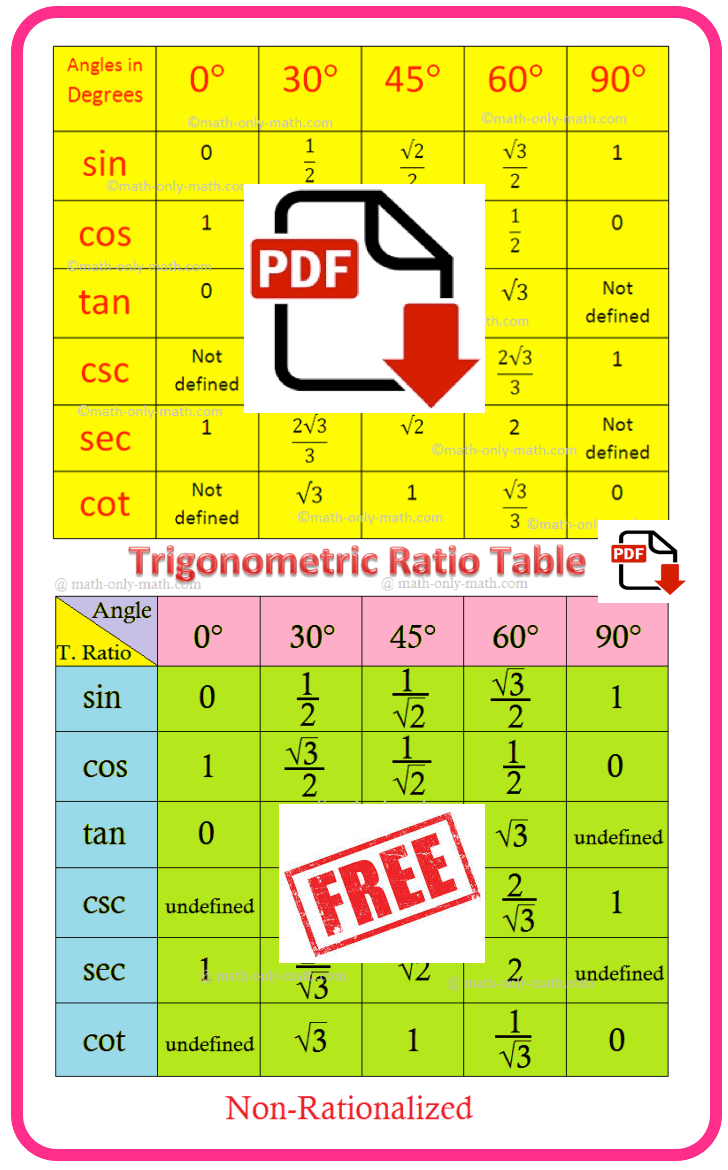
Download Free Trig Table PDF:
 |
 |
Trigonometric Ratios Table: Drag-and-Drop Game
Challenge1 of 12
Score0 / 120
Stars0
Drag the correct answer into the answer area. On a phone or tablet, tap a value first, then tap the answer area.
Game complete!
Answer review
| # | Challenge | Your answer | Correct answer | Result |
|---|
Easy Trick to Remember Trigonometric Values:
Memorization Tricks for Trigonometric Ratios Table:
To remember the above values:
(a) divide the numbers 0, 1, 2, 3 and 4 by 4,
(b) take the positive square roots,
(c) these numbers given the values of sin 0°, sin 30°, sin 45°, sin 60° and sin 90° respectively.
(d) write the values of sin 0°, sin 30°, sin 45°, sin 60° and sin 90° in reverse order and get the values of cos 0°, cos 30°, cos 45°, cos 60° and cos 90° respectively.
If θ be an acute angle, the values of sin θ and cos θ lies between 0 and 1 (both inclusive).
The sine of
the standard angles 0°, 30°, 45°, 60° and 90° are respectively the
positive square roots of 0/4, 1/4, 2/4, 3/4 and 4/4
Therefore,
sin 0° =
√(0/4) = 0
sin 30° = √(1/4) = ½
sin 45° = √(2/4) = 1/√2 = √2/2
sin 60° =
√3/4 = √3/2;
cos 90° =
√(4/4) = 1.
Similarly, cosine of the above standard angels are
respectively the positive square roots of 4/4, 3/4, 2/4, 1/4, 0/4
Therefore,
cos 0° =
√(4/4) = 1
cos 30° =
√(3/4) = √3/2
cos 45° = 1
cos 60° =
√(1/4) = 1/2
cos 90°
= √(0/4) = 0.
Since, we know the sin and cos value of the
standard angles from the trigonometrical ratios table; therefore we can easily find the
values of the other trigonometrical ratios of the standard angles.
The tangent of the standard angles 0°, 30°, 45°, 60° and 90°:
tan 0° = 0
tan 30° = √3/3
tan 45° = √(2/4) = 1/√2 = √2/2
tan 60° = √3
tan 90° = not defined.
The cosine of the standard angles 0°, 30°, 45°, 60° and 90°:
csc 0° = not defined.
csc 30° = 2
csc 45° = √2
csc 60° = 2√3/3
csc 90° = 1.
The secant of the standard angles 0°, 30°, 45°, 60° and 90°:
sec 0° = 1
sec 30° = 2√3/3
sec 45° = √2
sec 60° = 2
sec 90° = not defined.
The cotangent of the standard angles 0°, 30°, 45°, 60° and 90°:
cot 0° = not defined.
cot 30° = √3
cot 45° = 1
cot 60° = √3/3
cot 90° = 0
Note:
(i) For sin values: Start from 0 and go up.
(ii) For cos values: Start from 1 and go down.
This is why sin increases and cos decreases.
(iii) sin values go up cos values go down
(iv) At 45°, both are equal. This helps you avoid confusion.
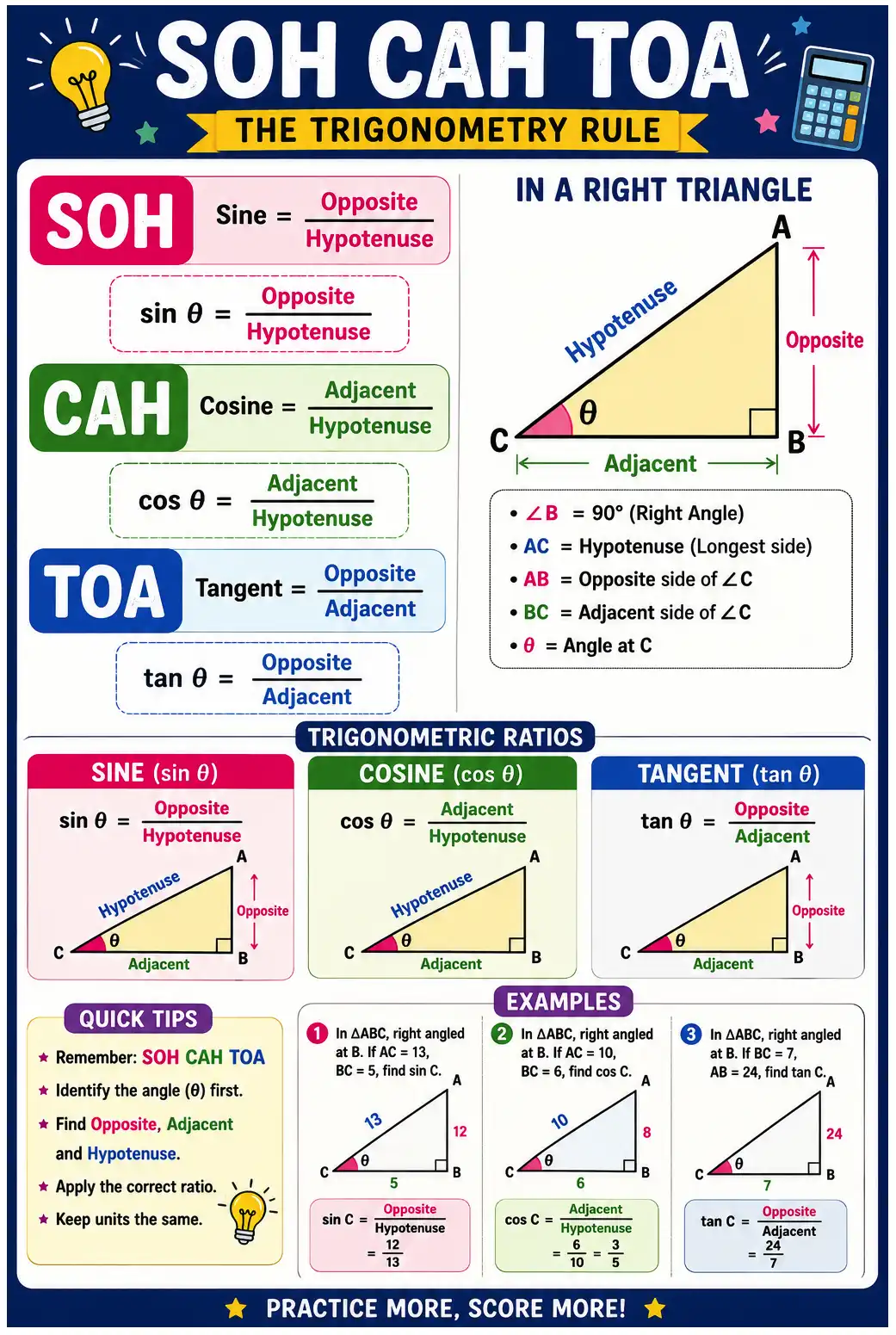
SOH CAH TOA Poster – Trigonometric Ratios Triangle Chart:
Learn SOH CAH TOA easily with this colorful trigonometric ratios poster showing the sine, cosine and tangent formulas for a right triangle.
Solved Examples on Trigonometrical Ratios Table:
1. If the csc of an angle complementary to A be \(\frac{2√3}{3}\), find tan A.
Solution:
sec (Complementary of ∠A) = \(\frac{2√3}{3}\)
[Using trigonometric ratio table, the value of csc 60° = \(\frac{2√3}{3}\)]
csc (Complementary of ∠A) = csc 60°
Complementary of ∠A = 60°
∠A = (90° – 60°)
∠A = 30°
Therefore, tan A = tan 30°
= \(\frac{√3}{3}\), [From Trig Ratios Table]
2. If A = 30° then show that, 2 sin A cos A = sin 2A
Solution:
L.H.S. = 2 sin A cos A
= 2 sin 30° cos 30°
[From the Trigonometrical Ratios Table, we get sin 30° = \(\frac{1}{2}\) and cos 30° = \(\frac{√3}{2}\)]
= 2 × \(\frac{1}{2}\) × \(\frac{√3}{2}\)
= \(\frac{√3}{2}\)
R.H.S. = sin 2A
= sin (2 × 30°)
= sin 60°
[From the Trigonometrical Ratios Table, we get sin 60° = \(\frac{√3}{2}\)]
= \(\frac{√3}{2}\)
Therefore, L.H.S. = R.H.S.
3. If A = 30° then show that, tan 2A = \(\frac{2 tan A}{1 – tan^{2} A}\).
Solution:
L.H.S. = tan 2A
= tan (2 × 30°)
= tan 60°
[From the Trigonometrical Ratios Table, we get tan 60° = √3]
= √3
R.H.S. = \(\frac{2 tan A}{1 – tan^{2} A}\)
= \(\frac{2 tan 30°}{1 – tan^{2} 30°}\)
[From the Trigonometric Ratios Table, we get tan 30° = \(\frac{√3}{3}\)]
= \(\frac{2 × \frac{√3}{3}}{1 – (\frac{√3}{3})^{2}}\)
= \(\frac{\frac{2√3}{3}}{1 – \frac{3}{9}}\)
= \(\frac{\frac{2√3}{3}}{\frac{9}{9} – \frac{3}{9}}\)
= \(\frac{\frac{2√3}{3}}{\frac{9 – 3}{9}}\)
= \(\frac{\frac{2√3}{3}}{\frac{6}{9}}\)
= \(\frac{\frac{2√3}{3}}{\frac{2}{3}}\)
= \(\frac{2√3}{3}\) × \(\frac{3}{2}\)
= \(\frac{6√3}{6}\)
= √3
Therefore, L.H.S. = R.H.S.
4. Find the exact value of sin 45° cos 30° + cos 45° sin 30° using trigonometric table.
Solution:
sin 45° cos 30° + cos 45° sin 30°
Plug-in the exact value of sin 45°, cos 30°, cos 45° and sin 30° from the trig ratios table
= \(\frac{√2}{2}\) × \(\frac{√3}{2}\) + \(\frac{√2}{2}\) × \(\frac{1}{2}\)
= \(\frac{√6}{4}\) + \(\frac{√2}{4}\)
= \(\frac{√6 + √2}{4}\)
5. tan \(\frac{π}{3}\), tan \(\frac{π}{4}\), tan \(\frac{π}{6}\) are in geometric progress.
Solution:
tan \(\frac{π}{3}\), tan \(\frac{π}{4}\), tan \(\frac{π}{6}\) are in geometric progress if,
tan\(^{2}\) \(\frac{π}{4}\) = tan \(\frac{π}{3}\) × tan \(\frac{π}{6}\)
Let’s check
L.H.S. = tan\(^{2}\) \(\frac{π}{4}\)
= (1)2, [From trig ratios table tan \(\frac{π}{4}\) = 1]
= 1
R.H.S. = tan \(\frac{π}{3}\) × tan \(\frac{π}{6}\)
= √3 × \(\frac{√3}{3}\)
= \(\frac{3}{3}\)
= 1
Therefore, an\(^{2}\) \(\frac{π}{4}\) = tan \(\frac{π}{3}\) × tan \(\frac{π}{6}\)
Thus, tan \(\frac{π}{3}\), tan \(\frac{π}{4}\), tan \(\frac{π}{6}\) are in G.P. (geometric progress).
6. Find the value of \(\frac{4}{3}\) tan2 60° + 3 cos2 30° – 2 sec2 30° – \(\frac{3}{4}\) cot2 60° using trigonometric table.
Solution:
The given trigonometric expression is
\(\frac{4}{3}\) tan2 60° + 3 cos2 30° – 2 sec2 30° – \(\frac{3}{4}\) cot2 60°
= \(\frac{4}{3}\) . (√3)2 + 3 . (\(\frac{√3}{2}\))2 – 2 . (\(\frac{2}{√3}\))2 – \(\frac{3}{4}\) . (\(\frac{1}{√3}\))2
[Since, the value of tan 60° = √3, cos 30° = \(\frac{√3}{2}\), sec 30° = \(\frac{2}{√3}\) and cot 60° = \(\frac{1}{√3}\)]
= \(\frac{4}{3}\) . 3 + 3 . \(\frac{3}{4}\) – 2 . \(\frac{4}{3}\) – \(\frac{3}{4}\) . \(\frac{1}{3}\)
= 4 + \(\frac{9}{4}\) – \(\frac{8}{3}\) – \(\frac{1}{4}\)
= \(\frac{10}{3}\)
= 3\(\frac{1}{3}\)
7. If A = 30°, show that cos 2A = cos2 A – sin2 A
Solution:
L.H.S. = cos 2A
= cos 2 . 30°
= cos 60°
= \(\frac{1}{2}\)
R.H.S. = cos2 A – sin2 A
= cos2 30° – sin2 30°
= (\(\frac{√3}{2}\))2 – (\(\frac{1}{2}\))2
= \(\frac{3}{4}\) – \(\frac{1}{4}\)
= \(\frac{1}{2}\)
Therefore, L.H.S. = R.H.S.
8. If A = 30°, show that 3 sin A – 4 sin3 A = sin 3A
Solution:
L.H.S. = 3 sin A – 4 sin3 A
= 3 sin 30° – 4 sin3 30°
= 3 . \(\frac{1}{2}\) – 4 (\(\frac{1}{2}\))3
= \(\frac{3}{2}\) – 4 . \(\frac{1}{8}\)
= \(\frac{3}{2}\) – \(\frac{1}{2}\)
= 1
= sin 90° (Using trigonometric table)
= sin 3 . 30°
= sin 3A = R.H.S.
Therefore, L.H.S. = R.H.S.
9. If the cosine of an angle complementary to θ be \(\frac{1}{2}\), find the value of cot θ.
Solution:
Angle complementary to θ is 90° – θ.
Therefore, by question, cos (90° – θ) = \(\frac{1}{2}\) = cos 60°
Therefore, 90° – θ = 60°
or, 90° – 60° = θ
or, θ = 30°
Therefore, cot θ = cot 30° = √3. (Using trigonometric table)
10. Find a value of θ which satisfies the equation cos 3θ = sin 2θ.
Solution:
Since, sin 2θ = cos (90° – 2θ),
Therefore, from the given equation we get,
cos 3θ = sin 2θ = cos (90° – 2θ)
Therefore, 3θ = 90° – 2θ
⟹ 3θ + 2θ = 90° – 2θ + 2θ; [Adding 2θ on both sides]
⟹ 5θ = 90°
⟹ θ = \(\frac{90}{5}\)°
⟹ θ = 18°
Therefore, the required value of θ is 18°.
11. Each angle A, B, C of the triangle ABC is acute and sin (B + C – A) = 1, tan (C + A – B) = √3; find A, B and C.
Solution:
Since A, B, C are the angle of ∆ABC
Therefore, A + B + C = 180° ………………. (i)
Again, sin (B + C – A) = 1 = sin 90° (Using trigonometry table)
Therefore, B + C – A = 90° ………………. (ii)
[Since each of the angles A, B, C is acute, hence, B + C > A]
And tan (C + A – B) = √3 = tan 60°, (Using trigonometry table)
Therefore, C + A – B = 60° ………………. (iii)
[Since each of the angles A, B, C is acute, hence, C + A > B]
Now we add the equations (ii) and (iii)
We get
(B + C – A) + (C + A – B) = 90° + 60°
⟹ (B + C – A + C + A – B) = 150°
⟹ 2C = 150°
⟹ C = \(\frac{150}{2}\)°
⟹ C = 75°
Again, we add the equations (i) and (ii)
(A + B + C) + (B + C – A) = 180° + 90°
⟹ (A + B + C + B + C – A) = 270°
⟹ 2B + 2C = 270°
⟹ 2B + 2(75°) = 270°; [Since C= 75°]
⟹ 2B + 150° = 270°
⟹ 2B = 270° – 150°
⟹ 2B = 120°
⟹ 2B = \(\frac{120}{2}\)°
⟹ B = 60°
Again, sin (B + C – A) = 1 = sin 90°
Now, putting the values of B and C in (i) we get,
A + 60° + 75° = 180°
⟹ A + 135° = 180°
⟹ A = 180° – 135°
⟹ A = 45°
Therefore, the required angles are:
A = 45°; B = 60°; C = 75°
12. If (x – 2)(sin \(\frac{π}{3}\) cos \(\frac{π}{6}\) + cos \(\frac{π}{3}\) sin \(\frac{π}{6}\)) = sec3 \(\frac{π}{3}\) + tan4 \(\frac{π}{4}\) – cosec2 \(\frac{π}{6}\), find the value of x.
Solution:
(x – 2)(sin \(\frac{π}{3}\) cos \(\frac{π}{6}\) + cos \(\frac{π}{3}\) sin \(\frac{π}{6}\)) = sec3 \(\frac{π}{3}\) + tan4 \(\frac{π}{4}\) – cosec2 \(\frac{π}{6}\)
⟹ (x – 2)(sin 60° cos 30° + cos 60° sin 30°) = sec3 60° + tan4 45° – cosec2 30°, [Since, π = 180°]
⟹ (x – 2)(\(\frac{√3}{2}\) . \(\frac{√3}{2}\) + \(\frac{1}{2}\) . \(\frac{1}{2}\)) = 23 + 14 – 22
⟹ (x – 2)(\(\frac{3}{4}\) + \(\frac{1}{4}\)) = 8 + 1 – 4
⟹ (x – 2)(\(\frac{3 + 1}{4}\)) = 5
⟹ (x – 2)(\(\frac{4}{4}\)) = 5
⟹ (x – 2) (1) = 5
⟹ x – 2 = 5
⟹ x = 5 + 2
⟹ x = 7
Therefore, the value of x = 7.
Difference Between Trigonometric and TableTrigonometric Formula:
Trigonometric Table |
Trigonometric Formula |
|
Shows values |
Shows identities |
|
Used for calculations |
Used for proofs |
|
Standard angles |
General equations |
Download Trigonometric Ratios Table PDF:
Trigonometric Ratios Table Quiz:
Question 1 of 10
Score: 0
Quiz complete!
Review your answers
| # | Question | Your answer | Correct answer | Result |
|---|
Quick Check Yourself: [🎯 Try these without looking at the table!]
1. What is sin 45° × cos 30°?
☐ √6/4; ☐ √2/4; ☐ 1/2
Show Answer
sin 45° = 1/√2
cos 30° = √3/2
Multiply:
(1/√2) × (√3/2)
= √3/(2√2)
= (√3 × √2)/(2√2 × √2)
= √6/4
✅ Correct Answer: √6 / 4
2. What is the value of tan 60° – tan 30° ?
☐ √3 – 1/√3; ☐ 1; ☐ √3
Show Answer
tan 60° = √3
tan 30° = 1/√3
tan 60° – tan 30°
= √3 – 1/√3
= (3 – 1)/√3
= 2 / √3
✅ Correct Answer: √3 – 1/√3
3. Which of the following is undefined?
☐ tan 90°; ☐ sin 90°; ☐ cos 0°
Show Answer
tan 90° is undefined.
sin 90° = 1
cos 90° = 0
Therefore, tan 90° = sin 90°/cos 90° = 1/0 = undefined
✅ Correct Answer: tan 90°
4. What is sec 60° × cos 60° ?
☐ 1; ☐ 2; ☐ 1/2
Show Answer
sec 60° = 2
cos 60° = 1/2
Therefore, sec 60° × cos 60°
= 2 × 1/2 = 1
✅ Correct Answer: 1
5. Evaluate: (1 + tan² 45°) / (1 + sec² 30°)
☐ 1/3; ☐ 7/6; ☐ 2/3
Show Answer
tan 45° = 1
Now, 1 + tan²45° = 1 + 1 = 2
Again, sec 30° = 2/√3
⟹ sec²30° = 4/3
⟹ 1 + sec²30° = 1 + 4/3 = 7/3
So, (1 + tan² 45°) / (1 + sec² 30°)
⟹ 2/(7/3)
⟹ 2 ÷ (7/3)
⟹ 6/7
✅ Correct Answer: 6/7
Worksheet on Trigonometrical Ratios Table:
Practice Questions:
1. If 30° then show that,
(i) 4 cos3 A – 3 cos A = cos 3A
(ii) \(\frac{1 – tan^{2} A}{1 + tan^{2} A}\) = cos 2A
2. If θ = 60° then prove that,
(i) cos θ = 2 cos2 \(\frac{θ}{2}\) – 1 = cos2 \(\frac{θ}{2}\) – sin2 \(\frac{θ}{2}\)
(ii) \(\frac{2 tan \frac{θ}{2}}{1 + tan^{2}\frac{θ}{2}}\) = sin θ
3. Find the values of:
(i) sin 45° cos 30 deg + cos 45° sin 30°
(ii) cos2 \(\frac{π}{4}\) – sin2 \(\frac{π}{6}\) + tan2 \(\frac{π}{3}\)
(iii) sin3 30° + 4 cot3 45° – cosec2 30°
(iv) cos \(\frac{π}{6}\) cot \(\frac{π}{3}\) + 2 . cos2 \(\frac{π}{3}\)
Answer:
3. (i) \(\frac{√3 + 1}{2√2}\)
(ii) 3\(\frac{1}{4}\)
(iii) \(\frac{1}{8}\)
(iv) 1
4. Prove that,
(i) \(\frac{(sin 0° + sin 60°)(cos 60° + cot 45°)}{(cot 60° + tan 30°)(cosec 30° – cosec 90°)}\) = \(\frac{9}{8}\)
(ii) cos2 60°, cos2 45°, cos2 30° are in A.P.
(iii) tan2 \(\frac{π}{3}\) – 2 tan2 \(\frac{π}{4}\) = cot2 \(\frac{π}{6}\) – 2 sin2 \(\frac{π}{6}\) – \(\frac{3}{4}\) cosec2 \(\frac{π}{4}\)
(iv) sec 60°, sec2 45°, sec2 30° are in H.P. (Harmonic Progression)
5. Find x if:
(i) (x + 1)cot2 \(\frac{π}{6}\) = 2 cos2 \(\frac{π}{3}\) + \(\frac{3}{4}\) sec2 \(\frac{π}{4}\) + 4 sin2 \(\frac{π}{6}\)
(ii) \(\frac{1 + 2 sin 60° cos 60°}{cos 60° + sin 60°}\) + \(\frac{1 – 2 sin 60° cos 60°}{sin 60° – cos 60°}\) = 2x
Answer:
5. (i) x = 0
(ii) x = \(\frac{√3}{2}\)
6. Solve (ϕ and β are positive acute angles): sin (ϕ – β) = \(\frac{1}{2}\); cos (ϕ + β)= \(\frac{1}{2}\) using trigonometry table.
Answer:
6. ϕ = 45° and β = 45°
7. The angle A of the triangle ABC is obtuse; if sec (B + C) cosec (B – C) = 2 find the angles.
Answer:
7. A = 120°, B = 45° and C = 15°
8. Salve ( 0 ≤ θ ≤ 90°)
(i) tan θ + cot θ = 2
(ii) 2 cos2 θ + 5 sin θ = 4
(iii) tan 2 θ – (√3 + 1) tan θ + √3 = 0
(iv) sec2 θ + tan2 θ = 7
(v) 2 sin2 θ = 3(1 – cos θ)
(vi) 2 sin θ tan θ + 1 = tan θ + 2 sin θ
(vi) tan θ – cot θ = cosec θ.
Answer:
8. (i) θ = 45°
(ii) θ = 30°
(iii) θ = 45°, 60°
(iv) θ = 60°
(v) θ = 0°, 60°
(vi) θ = 30°, 45°
(vi) θ = 60°
9. Find a value of β for each of the following equations:
(i) sin 4β = cos β
(ii) tan 3β = cot β
(iii) sin 3β = cos 7β
Answer:
9. (i) β = 18°
(ii) β = 22.5°
(iii) β = 9°
10. α, β, γ are positive angles acute and sin (α + β – γ) = cos (β + γ – α) = tan (γ + α – β) = 1 , find α, β, γ.
Answer:
10. α = 67.5°; β = 45°; γ = 22.5°
Frequently Asked Questions on Trigonometric Ratios Table:
Answer:
Trigonometric ratios are the ratios of the sides of a right-angled triangle. The main trigonometric ratios are sine (sin), cosine (cos), and tangent (tan). These ratios help us find angles and sides in triangles.
Answer:
The values of sin, cos, and tan depend on the angle. For example,
sin 30° = 1/2, cos 30° = √3/2, and tan 45° = 1. These values are commonly used in calculations.
Answer:
You can remember trigonometric ratios using tricks like the square root pattern method such as SOH-CAH-TOA. These methods make learning faster and easier.
Answer:
SOH-CAH-TOA is a memory trick.
SOH means sin = opposite / hypotenuse,
CAH means cos = adjacent / hypotenuse,
TOA means tan = opposite / adjacent.
Answer:
The standard angles are 0°, 30°, 45°, 60°, and 90°. These angles are used to create the trigonometric ratios table.
Answer:
Trigonometric ratios are important in engineering, architecture, physics, navigation, etc. They help measure distances and heights.
Answer:
sin 0° = 0 and sin 90° = 1. These are important values in trigonometry.
Answer:
No, tan 90° is not defined because the value becomes infinite.
Answer:
Sine is the ratio of opposite side to hypotenuse, while cosine is the ratio of adjacent side to hypotenuse.
Answer:
The reciprocal of sine is cosecant (cosec).
Answer:
Standard angles are important because they provide exact trigonometric values that make solving mathematical and real-life problems simpler, faster, and more accurate.
People Also Search For:
About Author

Written by Priyanka Ghosh
Mathematics Educator | Founder of Math Only Math
Priyanka Ghosh has been teaching elementary and middle-school mathematics for over 12 years and specializes in creating simple, child-friendly math lessons and worksheets.
Last Updated: July 2026
Reviewed by: Math Only Math Editorial Team
Educational Level: Class 9–12
Subject: Mathematics
Topic: Trigonometry
● Trigonometric Functions
From Trigonometrical Ratios Table to HOME PAGE
Didn’t find what you were looking for? Or want to know more information
about Math Only Math.
Use this Google Search to find what you need.